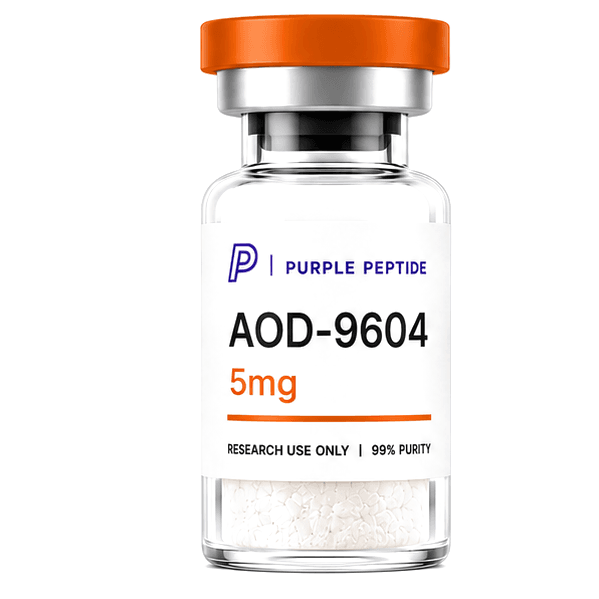
AOD-9604 research vial
Sequence length
16 AA
Molecular weight
1815.12 g/mol
Current batch
AOD96202602
Metabolic · Metabolic / Adipose tissue and lipolysis research

AOD-9604

Modified 16-amino-acid C-terminal fragment of human growth hormone (hGH 177-191)

AOD-9604 (5mg vials)

Sign up for verified researcher access to view pricing, see in-stock quantity, and order at member volume tiers (up to 20% off at 20+ vials).

Sign up to view pricing and order.Verified researchers only. Active immediately on sign-up.
Apply for access →

Specifications

Molecular weight1815.12 g/mol
Sequence length16 amino acids
Amino acid sequenceTyr-Leu-Arg-Ile-Val-Gln-Cys-Arg-Ser-Val-Glu-Gly-Ser-Cys-Gly-Phe (disulfide bridge Cys7–Cys14)
AppearanceWhite lyophilized powder
SolubilityBacteriostatic water; sterile water
Storage (lyophilized)-20°C, protected from light
Storage (reconstituted)2–8°C, use within 28 days
Half-lifeApproximately 4 hours after subcutaneous administration in published studies
Current batch purity99.48% (HPLC) · AOD96202602

AOD-9604 (Anti-Obesity Drug 9604) is a synthetic 16-amino-acid peptide based on the C-terminal lipolytic region of human growth hormone (hGH residues 177–191), with an additional N-terminal tyrosine and a disulfide bridge between the two cysteine residues. Originally developed at Monash University in Australia and subsequently licensed to Metabolic Pharmaceuticals, AOD-9604 was investigated as an oral anti-obesity candidate and progressed through Phase 2 clinical evaluation in humans. AOD-9604 is supplied by NovaWell as a lyophilized powder, third-party tested for purity and endotoxin conformance, for laboratory research use only.

Research Studies

The following studies are summarized for educational purposes only. Inclusion does not imply any human use; all referenced research was conducted in vitro, in animal models, or in regulated clinical trials.

Research study

The lipolytic and antilipogenic activity of a synthetic peptide corresponding to the C-terminal sequence of human growth hormone is mediated by the β3-adrenergic receptor

Heffernan M, Summers RJ, Thorburn A, Ogru E, Gianello R, Jiang WJ, Ng FM. Endocrinology. 2001;142(12):5182–5189. View source ↗

Scientific findings

This study examined the mechanism of action of AOD-9604, a synthetic analogue of the hGH 177–191 fragment, in wild-type and β3-adrenergic receptor (β3-AR) knockout mice. In obese (ob/ob) mice, chronic administration of AOD-9604 was associated with reduced cumulative body-weight gain, increased lipolysis in isolated adipocytes, and upregulation of β3-AR mRNA expression in adipose tissue. The chronic weight-reducing and lipolytic responses were substantially attenuated in β3-AR knockout animals, supporting a β3-AR–dependent component of the fragment's metabolic activity. The authors concluded that the lipolytic action of the hGH C-terminal fragment is at least partly mediated through the β3-adrenergic pathway in adipocytes and does not require the canonical growth hormone receptor signaling responsible for IGF-1 elevation and insulin antagonism.

Plain English

Scientists tested how a small piece of growth hormone called AOD-9604 affects fat cells in mice. They found that the peptide pushes fat cells to break down stored fat, and it appears to work by amplifying signals through a specific receptor on fat cells called the β3-adrenergic receptor — the same receptor that normally responds to adrenaline-like signals to mobilize energy. When the researchers tested the peptide in mice genetically engineered without that receptor, much of the fat-loss effect disappeared, suggesting the receptor is an important part of the pathway. Importantly, the peptide did not produce the blood-sugar or growth effects associated with full-length growth hormone.

Research study

Effects of oral administration of a synthetic fragment of human growth hormone on lipid metabolism

Ng FM, Sun J, Sharma L, Libinaka R, Jiang WJ, Gianello R. Am J Physiol Endocrinol Metab. 2000;279(3):E501–E509. View source ↗

Scientific findings

This animal study investigated the lipid-metabolism effects of the synthetic hGH C-terminal fragment when administered orally to obese (ob/ob) mice. Researchers reported that oral administration was associated with reduced cumulative body-weight gain and reduced adipose tissue mass relative to untreated controls. In isolated adipocytes, the fragment was associated with stimulation of hormone-sensitive lipase activity and inhibition of acetyl-CoA carboxylase, consistent with simultaneous enhancement of lipolysis and suppression of lipogenesis. The data supported the hypothesis that the C-terminal lipolytic domain of hGH can be separated from the growth-promoting and diabetogenic actions of the full hormone, and that the isolated fragment retains metabolic activity on adipose tissue when delivered orally in a rodent model.

Plain English

Researchers gave obese mice a small fragment of growth hormone by mouth and watched what happened to their body weight and fat tissue. The mice gained less weight and accumulated less fat compared with untreated mice. When the team looked inside fat cells, they saw two changes happening at once — the machinery that breaks fat down was more active, and the machinery that builds new fat was less active. The takeaway was that this short fragment kept the fat-related effects of growth hormone but left behind the blood-sugar and growth effects, which is why it was attractive as a candidate for further obesity research.

Storage & handling

Lyophilized (unreconstituted): Store at -20°C, protected from light. Stable for 24+ months under correct storage. Avoid repeated temperature cycling.

Reconstituted: Dissolve in bacteriostatic water (typically 1–2 mL per 5 mg vial, depending on the research protocol). Store reconstituted solution at 2–8°C and use within 28 days. Do not freeze reconstituted solution.

Vial format: 5 mg lyophilized, vacuum-sealed glass vial with rubber stopper and aluminum crimp. Sterility tested per USP guidelines.

Shipping: Lyophilized AOD-9604 is stable at ambient temperature for the typical 1–3 day shipping window. Cold-pack shipping available on request.

Frequently asked questions

What is AOD-9604?+

AOD-9604 (Anti-Obesity Drug 9604) is a synthetic 16-amino-acid peptide modeled on the C-terminal lipolytic region of human growth hormone. It was developed at Monash University in Australia in the 1990s and progressed through Phase 1 and Phase 2 clinical evaluation as an oral candidate for obesity research. The larger 2007 Phase 2b multicentre study in 536 subjects over 24 weeks did not meet its primary efficacy endpoint versus placebo, and the obesity development program was subsequently wound down.

How is AOD-9604 derived from human growth hormone?+

AOD-9604 corresponds to residues 177–191 of human growth hormone — the C-terminal lipolytic domain — with an additional N-terminal tyrosine, giving a 16-amino-acid sequence: Tyr-Leu-Arg-Ile-Val-Gln-Cys-Arg-Ser-Val-Glu-Gly-Ser-Cys-Gly-Phe. The two cysteine residues form an intramolecular disulfide bridge (Cys7–Cys14). The molecular formula is C78H123N23O23S2 with a molecular weight of approximately 1815.12 g/mol (CAS 221231-10-3).

What is the proposed mechanism of action of AOD-9604?+

Published mechanistic work in rodents (Heffernan et al., 2001) reported that AOD-9604 is associated with stimulation of lipolysis and inhibition of lipogenesis in adipocytes, and that a significant portion of this activity appears to depend on the β3-adrenergic receptor in adipose tissue. Unlike full-length growth hormone, the isolated fragment did not produce IGF-1 elevation or measurable insulin antagonism in the published studies. The fragment is not believed to act through the canonical growth hormone receptor.

How is AOD-9604 different from GLP-1 receptor agonist analogs?+

AOD-9604 and GLP-1 receptor agonist analogs (such as the molecules described in this catalog as GLP-1 S and GLP-1 T) are mechanistically unrelated. GLP-1 receptor agonists act primarily on the GLP-1 receptor in the pancreas, gut, and central nervous system, affecting insulin secretion, gastric emptying, and appetite. AOD-9604 is a growth-hormone-derived fragment studied for direct effects on adipocyte lipolysis via the β3-adrenergic pathway. The two have different research histories, different clinical-trial outcomes, and act on distinct receptor systems.

What does NovaWell test AOD-9604 for?+

Every batch of AOD-9604 supplied by NovaWell is tested by an independent third-party laboratory for: identity and purity (HPLC + MS), bacterial endotoxin (USP <85>), heavy metals (USP), and sterility (USP). The Certificate of Analysis for the currently shipping batch is linked from the Certificates tab on this page.

How should AOD-9604 be stored after reconstitution?+

Once reconstituted in bacteriostatic water, AOD-9604 should be stored at 2–8°C and used within 28 days. Do not freeze reconstituted solution. The lyophilized 5 mg vial is stable at -20°C for 24+ months when kept protected from light and away from temperature cycling.