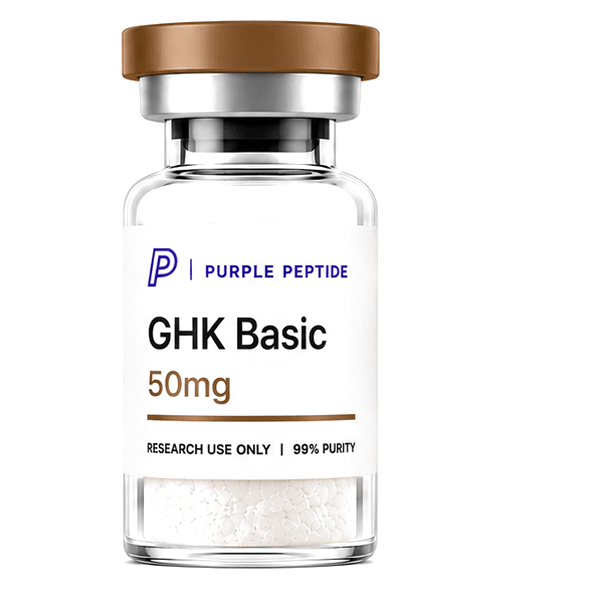
GHK Basic research vial
Sequence length
3 AA
Molecular weight
340.4 g/mol (free tripeptide; distinct from 397.9 g/mol GHK-Cu complex)
Current batch
GHKBA202603
Dermal · Skin biology / Tissue remodeling research

GHK Basic

Glycyl-L-histidyl-L-lysine tripeptide — the free peptide form, supplied as a sterile-filtered 50mg vialed presentation

GHK Basic (50mg vial)

Sign up for verified researcher access to view pricing, see in-stock quantity, and order at member volume tiers (up to 20% off at 20+ vials).

Sign up to view pricing and order.Verified researchers only. Active immediately on sign-up.
Apply for access →

Specifications

Molecular weight340.4 g/mol (free tripeptide; distinct from 397.9 g/mol GHK-Cu complex)
Sequence length3 amino acids
Amino acid sequenceGly-His-Lys
AppearanceWhite to off-white lyophilized cake (no copper bound)
SolubilityBacteriostatic water; sterile water
Storage (lyophilized)-20°C, protected from light
Storage (reconstituted)2–8°C, use within 28 days
Current batch purity99.35% (HPLC) · GHKBA202603

GHK Basic is the naturally occurring tripeptide glycyl-L-histidyl-L-lysine (Gly-His-Lys), originally isolated from human plasma by Pickart in 1973, supplied as a sterile-filtered, vialed 50 mg presentation in the free peptide form — GHK without a copper ion bound to it. It appears as a white to off-white lyophilized cake rather than the deep blue of the GHK-Cu complex. The free peptide has high affinity for Cu(II) and will form GHK-Cu when a copper source is introduced in solution. NovaWell supplies GHK Basic as a 50 mg vial, third-party tested for identity, purity, endotoxin, sterility, and absence of copper, for laboratory research use only.

Research Studies

The following studies are summarized for educational purposes only.

Research study

GHK Peptide as a Natural Modulator of Multiple Cellular Pathways in Skin Regeneration

Pickart L, Vasquez-Soltero JM, Margolina A. Biomed Res Int. 2015;2015:648108. View source ↗

Scientific findings

This review synthesizes the molecular biology of GHK across multiple cellular systems relevant to dermal research. The authors describe the discovery of GHK in human plasma in 1973 at approximately 200 μg/L in young adults, declining to roughly 80 μg/L by age 60–80, and summarize the peptide's high affinity for Cu(II) which drives formation of the GHK-Cu complex in physiological conditions. Reported in vitro effects of GHK (both the free peptide and the copper complex) include modulation of extracellular matrix gene expression — collagen, elastin, glycosaminoglycan synthesis — alongside fibroblast proliferation and induction of antioxidant genes. The authors note that biological activity in most preclinical models is attributed to the copper-bound complex rather than the free peptide alone, and discuss the equilibrium between the two forms in biological media.

Plain English

Researchers reviewed what is known about GHK in skin biology. GHK was discovered in human blood in 1973, and levels drop with age. The peptide on its own binds tightly to copper ions, and in most lab studies it is actually the copper-bound form (GHK-Cu) that does the work — switching on genes that build collagen and elastin, waking up the cells that produce these proteins, and turning on the cell's antioxidant defenses. The review explains that plain GHK and GHK-Cu exist in equilibrium in biological fluids depending on how much copper is present.

Research study

Regenerative and Protective Actions of the GHK-Cu Peptide in the Light of the New Gene Data

Pickart L, Margolina A. Int J Mol Sci. 2018;19(7):1987. View source ↗

Scientific findings

Using gene-expression datasets from the Broad Institute's Connectivity Map, the authors analyzed GHK's effect on the transcriptome of human cells. GHK exposure was associated with statistically significant modulation of more than 4,000 genes, with effects clustering around DNA repair pathways, ubiquitin-proteasome regulation, antioxidant defense, and inflammatory signaling. The authors discuss the relationship between the free peptide and the copper-bound complex, noting that GHK introduced into cell culture media containing trace copper will form GHK-Cu, complicating attribution of observed gene-expression changes to one form or the other.

Plain English

Scientists used a large public database of gene activity to look at how GHK changes which genes are turned on or off in human cells. They found GHK affects thousands of genes — particularly ones involved in fixing DNA, recycling damaged proteins, calming inflammation, and protecting against oxidative damage. The authors point out that even when researchers add plain GHK to cells, copper already present in the growth medium can bind to it, so the observed effects may reflect the copper-bound form rather than the free peptide.

Storage & handling

Lyophilized: Store at -20°C, protected from light. GHK Basic is a white to off-white lyophilized cake — unlike GHK-Cu, it has no blue color, because no copper is bound.

Reconstituted: Bacteriostatic water (volume chosen by the researcher to suit the assay concentration). Store at 2–8°C and use within 28 days. Avoid freeze-thaw cycles.

Vial format: 50 mg sterile-filtered, lyophilized, vacuum-sealed glass vial.

Shipping: Stable at ambient temperature for the typical 1–3 day shipping window.

Frequently asked questions

What is GHK Basic?+

GHK Basic is the free tripeptide glycyl-L-histidyl-L-lysine (Gly-His-Lys), molecular weight 340.4 g/mol, supplied as a sterile-filtered, vialed 50 mg lyophilized presentation. It was first isolated from human plasma by Loren Pickart in 1973 and is also found in saliva and urine. Plasma concentrations decline with age, from roughly 200 μg/L in young adults to around 80 μg/L by age 60–80.

How does GHK Basic differ from GHK Powder?+

Both are the same free GHK tripeptide. GHK Basic is the larger 50 mg sterile-filtered, vialed presentation. GHK Powder is the raw 5 mg lyophilized material for researchers who want bulk peptide to weigh out and prepare themselves. Choose based on the scale and format your protocol calls for; each ships with its own Certificate of Analysis.

GHK vs GHK-Cu — what's the difference?+

GHK is the free tripeptide on its own. GHK-Cu is the same tripeptide with a copper(II) ion bound to it, forming a stable complex with a molecular weight of approximately 397.9 g/mol. The most visible difference is color: plain GHK is a white to off-white powder, while GHK-Cu is a deep blue powder because the bound copper absorbs strongly in the visible spectrum. In biological media, plain GHK has high affinity for Cu(II) and will partially bind copper present in the medium, forming GHK-Cu in situ — so the two forms exist in equilibrium depending on copper availability. Much of the preclinical literature attributes the gene-expression and tissue-remodeling effects to the copper-bound complex rather than the free peptide.

What does NovaWell test GHK Basic for?+

Identity and purity by HPLC and MS, absence of copper by ICP-MS (a free-GHK release spec — copper must be below the LOQ, confirming the product is the free peptide and not the copper complex), bacterial endotoxin per USP <85>, heavy metals per USP, and sterility per USP. The current batch's COA is in the Certificates tab.

How is GHK Basic typically dissolved?+

Researchers typically dissolve GHK in bacteriostatic water or sterile water for in vitro work, with the volume chosen to suit the assay concentration. Adding plain GHK to cell-culture media containing trace copper will result in partial in-solution formation of GHK-Cu; researchers studying the free peptide specifically often use copper-controlled buffers. The reconstituted solution should be stored refrigerated and used within 28 days.