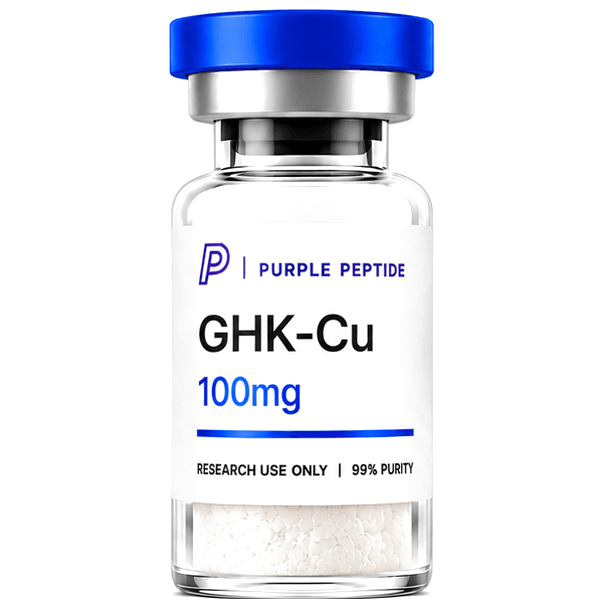
GHK-Cu research vial
Sequence length
3 AA
Molecular weight
340.4 g/mol (free peptide); ~397.9 g/mol (GHK-Cu complex)
Current batch
GHKCU202605
Dermal · Skin biology / Tissue remodeling research

GHK-Cu

Copper-binding tripeptide (Gly-His-Lys) complexed with Cu(II)

GHK-Cu (100mg vials)

Sign up for verified researcher access to view pricing, see in-stock quantity, and order at member volume tiers (up to 20% off at 20+ vials).

Sign up to view pricing and order.Verified researchers only. Active immediately on sign-up.
Apply for access →

Specifications

Molecular weight340.4 g/mol (free peptide); ~397.9 g/mol (GHK-Cu complex)
Sequence length3 amino acids
Amino acid sequenceGly-His-Lys
AppearanceBlue lyophilized powder (copper-bound)
SolubilityBacteriostatic water; sterile water
Storage (lyophilized)-20°C, protected from light
Storage (reconstituted)2–8°C, use within 28 days
Current batch purity99.64% (HPLC) · GHKCU202605

GHK-Cu is a naturally occurring tripeptide (Gly-His-Lys) bound to a copper(II) ion, originally identified in human plasma. The peptide-copper complex is widely studied in vitro and in animal models for roles in skin remodeling, wound healing, antioxidant signaling, and modulation of gene expression. NovaWell supplies GHK-Cu as a lyophilized blue powder in 100 mg vials, third-party tested for purity, endotoxin, and sterility, for laboratory research use only.

Research Studies

The following studies are summarized for educational purposes only.

Research study

GHK Peptide as a Natural Modulator of Multiple Cellular Pathways in Skin Regeneration

Pickart L, Vasquez-Soltero JM, Margolina A. Biomed Res Int. 2015;2015:648108. View source ↗

Scientific findings

This review synthesizes the molecular biology of GHK and the GHK-Cu complex across multiple cellular systems relevant to dermal research. The authors describe GHK-Cu's role in modulating expression of genes involved in extracellular matrix remodeling — including collagen, elastin, and glycosaminoglycan synthesis — and its activation of fibroblast and endothelial cell proliferation in vitro. Reported effects on antioxidant defense include induction of metallothioneins and modulation of oxidative stress markers. The review summarizes preclinical evidence for GHK-Cu's effects on tissue remodeling, hair follicle biology, and DNA damage repair pathways in cultured cells and animal models.

Plain English

Researchers reviewed everything known at the time about how GHK-Cu affects skin cells. In lab studies, the peptide-copper complex appears to switch on genes that build the structural proteins skin needs — collagen, elastin, and the gels that hold them together. It also wakes up the cells that produce these proteins and helps blood vessels grow into healing tissue. Animal studies show it speeds up wound closure and reduces signs of cellular oxidative damage.

Research study

Regenerative and Protective Actions of the GHK-Cu Peptide in the Light of the New Gene Data

Pickart L, Margolina A. Int J Mol Sci. 2018;19(7):1987. View source ↗

Scientific findings

Using gene-expression datasets from the Broad Institute's Connectivity Map, the authors analyzed GHK's effect on the transcriptome of human cells. GHK exposure was associated with statistically significant modulation of more than 4,000 genes, with effects clustering around DNA repair pathways, ubiquitin-proteasome regulation, antioxidant defense, and inflammatory signaling. The authors propose that GHK-Cu's broad observed effects in preclinical models reflect this transcriptome-wide signaling rather than action on a single receptor.

Plain English

Scientists used a large public database of gene activity to look at how GHK changes which genes are turned on or off in human cells. They found GHK affects thousands of genes — particularly ones involved in fixing DNA, recycling damaged proteins, calming inflammation, and protecting against oxidative damage. This suggests GHK doesn't have just one job: it acts like a master switch that adjusts many cellular maintenance programs at once.

Storage & handling

Lyophilized: Store at -20°C, protected from light. The characteristic blue color reflects the bound copper; significant color loss may indicate degradation.

Reconstituted: Bacteriostatic water (typically 2–4 mL per 100 mg vial). Store at 2–8°C and use within 28 days. Avoid freeze-thaw cycles.

Vial format: 100 mg lyophilized, vacuum-sealed glass vial.

Shipping: Stable at ambient temperature for the 1–3 day shipping window.

Frequently asked questions

What is GHK-Cu?+

GHK-Cu is the tripeptide glycyl-L-histidyl-L-lysine (GHK, 340.4 g/mol) complexed with a copper(II) ion. The complex has a characteristic deep blue color. GHK was first identified in human plasma in the 1970s and has been the subject of extensive in vitro and animal-model research since.

Why is the powder blue?+

The blue color comes from the bound copper(II) ion. GHK and Cu(II) form a stable complex with strong absorbance in the visible spectrum. If a GHK-Cu product is white, it likely does not contain copper.

What does NovaWell test GHK-Cu for?+

Identity and purity by HPLC and MS, copper content by ICP-MS, bacterial endotoxin per USP <85>, heavy metals per USP, and sterility per USP. The current batch's COA is in the Certificates tab.

How is GHK-Cu typically dissolved?+

Researchers typically dissolve GHK-Cu in bacteriostatic water for in vitro work, with the volume chosen to suit the assay concentration. The reconstituted solution should be stored refrigerated and used within 28 days.

Where does NovaWell source GHK-Cu?+

Sourced from a vetted synthesis partner under our supplier qualification protocol, then independently verified by a third-party laboratory before release. The manufacturer ID for the current batch is in the Description tab.

Is GHK-Cu stable in shipping?+

Lyophilized GHK-Cu is stable at ambient temperature for the typical 1–3 day shipping window. Long-term storage at -20°C is recommended.