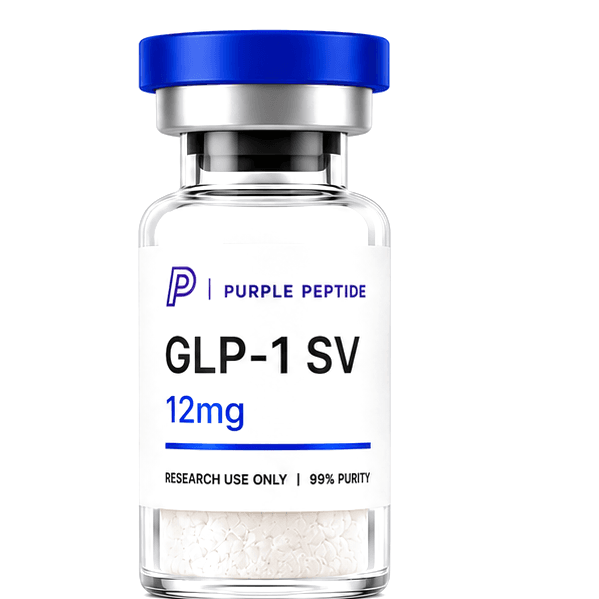
GLP-1 SV research vial
Sequence length
29 AA
Molecular weight
~4280 g/mol
Current batch
GLP1S202605
Metabolic · Dual incretin/glucagon receptor pharmacology / Metabolic and hepatic research

GLP-1 SV

Dual GLP-1 / glucagon receptor agonist

GLP-1 SV (12mg vials)

Sign up for verified researcher access to view pricing, see in-stock quantity, and order at member volume tiers (up to 20% off at 20+ vials).

Sign up to view pricing and order.Verified researchers only. Active immediately on sign-up.
Apply for access →

Specifications

Molecular weight~4280 g/mol
Sequence length29 amino acids
ModificationsGlucagon/GLP-1 backbone with fatty-acid acylation for albumin binding and extended half-life
Parent receptorGlucagon receptor (GCGR) and glucagon-like peptide-1 receptor (GLP-1R)
AppearanceWhite lyophilized powder
SolubilityBacteriostatic water; sterile water
Storage (lyophilized)-20°C, protected from light
Storage (reconstituted)2–8°C, use within 28 days
Current batch purity99.44% (HPLC) · GLP1S202605

GLP-1 SV is the research code NovaWell uses for the investigational dual receptor agonist known in the published clinical-trial literature as Survodutide (developmental code BI 456906). The molecule is a dual agonist of the glucagon receptor (GCGR) and the glucagon-like peptide-1 receptor (GLP-1R), combining glucagon-mediated effects on energy expenditure and hepatic lipid handling with GLP-1-mediated effects on appetite and glucose homeostasis. It is being studied in preclinical and clinical research for body-weight modulation, hepatic steatosis, and metabolic dysfunction-associated steatohepatitis (MASH). NovaWell supplies GLP-1 SV as a lyophilized powder in 12 mg vials, third-party tested, for laboratory research use only. Reference to the molecule in published literature does not imply suitability for any human application.

Research Studies

The following studies are summarized for educational purposes only. Reference to clinical-trial literature describes published research findings, not any endorsement of human use of the research-grade compound supplied here.

Research study

Glucagon and GLP-1 receptor dual agonist survodutide for obesity: a randomised, double-blind, placebo-controlled, dose-finding phase 2 trial

Le Roux CW, Steen O, Lucas KJ, Startseva E, Unseld A, Hennige AM. Lancet Diabetes Endocrinol. 2024;12(3):162–173. View source ↗

Scientific findings

This randomized, double-blind, placebo-controlled dose-finding Phase 2 trial enrolled 387 adults with body mass index ≥27 without type 2 diabetes. Participants were assigned to once-weekly subcutaneous survodutide (target maintenance doses 0.6, 2.4, 3.6, or 4.8 mg) or placebo for 46 weeks following a titration period. Mean percentage body-weight reduction at week 46 was up to -14.9% across active arms versus -2.8% with placebo, with completers in the 4.8 mg arm achieving a mean reduction of -18.7%. Secondary endpoints — including the proportion achieving ≥5%, ≥10%, and ≥15% weight reduction — favored survodutide. Adverse events were predominantly gastrointestinal and consistent with the incretin pharmacology class profile.

Plain English

Researchers ran a 46-week study comparing weekly survodutide injections at several doses to placebo in nearly 400 adults with overweight or obesity (without diabetes). Average weight loss reached about 15% on survodutide and roughly 19% in the highest-dose group who completed the trial, compared with about 3% on placebo. Side effects were mainly stomach-related (nausea, vomiting, diarrhea), which is typical for this class of molecule.

Research study

A Phase 2 Randomized Trial of Survodutide in MASH and Fibrosis

Sanyal AJ, Bedossa P, Fraessdorf M, et al. N Engl J Med. 2024;391(4):311–319. View source ↗

Scientific findings

This Phase 2, randomized, double-blind, placebo-controlled trial evaluated weekly subcutaneous survodutide in 295 adults with biopsy-confirmed metabolic dysfunction-associated steatohepatitis (MASH) and fibrosis stages F1–F3. Participants were assigned to survodutide (target maintenance doses 2.4, 4.8, or 6.0 mg) or placebo for 48 weeks. The primary endpoint — histological improvement of MASH without worsening of fibrosis — was achieved by up to 83% of participants in pooled survodutide arms versus 18% with placebo. Secondary endpoints showed reductions in liver fat content of ≥30% in 63–67% of survodutide-treated participants and improvement in fibrosis by ≥1 stage in 34–36% versus 22% with placebo. Adverse events were predominantly gastrointestinal.

Plain English

A 48-week study tested weekly survodutide in about 300 adults with MASH (a liver condition involving fat, inflammation, and scarring). Up to 83% of participants on survodutide showed improvement in MASH on biopsy without their fibrosis getting worse, compared with 18% on placebo. Liver fat dropped substantially in most participants in the active arms, and a meaningful share also showed improvement in fibrosis. Side effects were mostly gastrointestinal.

Storage & handling

Lyophilized: Store at -20°C, protected from light. Stable for 24+ months.

Reconstituted: Bacteriostatic water. Store reconstituted solution at 2–8°C and use within 28 days. Do not freeze.

Vial format: 12 mg lyophilized, vacuum-sealed glass vial.

Shipping: Lyophilized GLP-1 SV is stable at ambient temperature for the typical 1–3 day shipping window. Cold-pack shipping available on request.

Frequently asked questions

What is GLP-1 SV?+

GLP-1 SV is the research code NovaWell uses for the molecule known in the published literature as Survodutide (developmental code BI 456906). It is an investigational dual receptor agonist that activates both the glucagon receptor (GCGR) and the glucagon-like peptide-1 receptor (GLP-1R). The dual-receptor profile combines glucagon-mediated effects on hepatic lipid handling and energy expenditure with GLP-1-mediated effects on appetite and glucose homeostasis. It is supplied here as a research-grade lyophilized powder for laboratory use only.

What is the dual mechanism, and why does it matter for research?+

GLP-1 SV binds and activates two receptors simultaneously. GLP-1 receptor activation modulates appetite signaling and slows gastric emptying; glucagon receptor activation increases hepatic lipid oxidation and resting energy expenditure. The combined pharmacology is of particular interest in preclinical and clinical research on hepatic steatosis and MASH, where reducing liver fat is a primary endpoint distinct from body-weight reduction alone.

How does GLP-1 SV differ from GLP-1 M, GLP-1 T, and GLP-3 R?+

All four molecules are multi-receptor incretin-related agonists with distinct receptor profiles. GLP-1 SV is a GLP-1/glucagon dual agonist. GLP-1 M is also a GLP-1/glucagon dual agonist but is a structurally distinct molecule (derived from oxyntomodulin) with a different pharmacokinetic and receptor-balance profile. GLP-1 T is a GLP-1/GIP dual agonist, substituting GIP receptor activity for glucagon receptor activity. GLP-3 R is a triple agonist that activates GLP-1, GIP, and glucagon receptors. The four molecules are pharmacologically and structurally distinct and are not interchangeable in research protocols.

What does NovaWell test GLP-1 SV for?+

Identity and purity by HPLC and mass spectrometry, bacterial endotoxin per USP <85>, heavy metals per USP, and sterility per USP. The COA for the current batch is in the Certificates tab.

What is the current batch's purity?+

The purity of the currently shipping batch is listed in the Certificates tab, along with the test date and the third-party laboratory that conducted the analysis. Recent batches have tested at 99%+ pure.

How should GLP-1 SV be stored?+

Lyophilized GLP-1 SV should be stored at -20°C and protected from light; under these conditions it is stable for 24+ months. After reconstitution with bacteriostatic water, the solution should be refrigerated at 2–8°C and used within 28 days. Do not freeze the reconstituted solution. Lyophilized material tolerates the typical 1–3 day ambient shipping window.