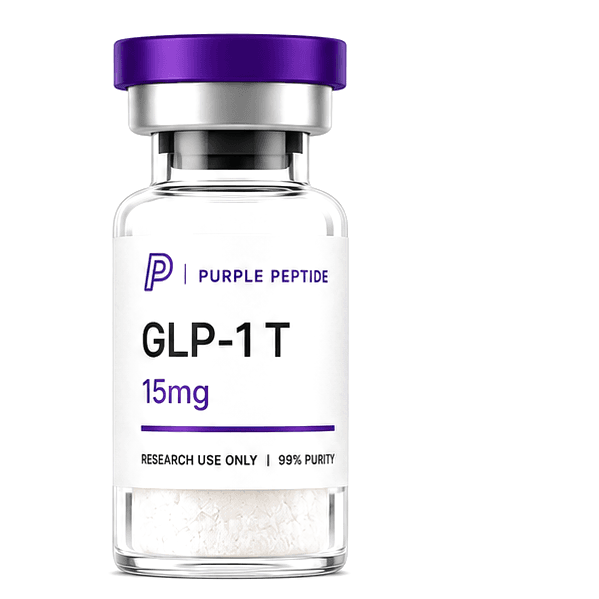
GLP-1 T research vial
Sequence length
39 AA
Molecular weight
~4813.5 g/mol
Current batch
GLP1T202604
Metabolic · Incretin pharmacology / Metabolic research

GLP-1 T

Dual GLP-1 and GIP receptor agonist analog

GLP-1 T (40mg vials)

Sign up for verified researcher access to view pricing, see in-stock quantity, and order at member volume tiers (up to 20% off at 20+ vials).

Sign up to view pricing and order.Verified researchers only. Active immediately on sign-up.
Apply for access →

Specifications

Molecular weight~4813.5 g/mol
Sequence length39 amino acids
ModificationsAib at positions 2 and 13; Lys-20 acylated with C20 fatty diacid via gamma-Glu-2xOEG linker
Parent receptorsGLP-1R and GIP receptor (dual agonist)
AppearanceWhite lyophilized powder
SolubilityBacteriostatic water; sterile water
Storage (lyophilized)-20°C, protected from light
Storage (reconstituted)2–8°C, use within 28 days
Current batch purity99.86% (HPLC) · GLP1T202604

GLP-1 T is the research code NovaWell uses for the 39-amino-acid synthetic peptide known in the published clinical-trial literature as Tirzepatide. The molecule functions as a dual agonist at the glucagon-like peptide-1 (GLP-1) receptor and the glucose-dependent insulinotropic polypeptide (GIP) receptor. Its structural modifications — aminoisobutyric acid substitutions and a fatty-acid side chain — extend plasma half-life for weekly dosing in clinical-research settings. The molecule is the subject of an extensive randomized-trial literature on glucose homeostasis and body-weight regulation. NovaWell supplies GLP-1 T as a lyophilized powder in 40 mg vials for laboratory research only.

Research Studies

Research study

Tirzepatide versus Semaglutide Once Weekly in Patients with Type 2 Diabetes (SURPASS-2)

Frías JP, Davies MJ, Rosenstock J, et al. N Engl J Med. 2021;385(6):503–515. View source ↗

Scientific findings

SURPASS-2 was a 40-week open-label, randomized, head-to-head trial of tirzepatide (5 mg, 10 mg, or 15 mg weekly) versus semaglutide 1 mg weekly in 1,879 patients with type 2 diabetes on metformin. Mean HbA1c reductions were -2.01% (5 mg), -2.24% (10 mg), -2.30% (15 mg) for tirzepatide versus -1.86% for semaglutide. Body weight reductions were -7.6, -9.3, -11.2 kg for the tirzepatide arms versus -5.7 kg for semaglutide. All tirzepatide doses met non-inferiority and superiority criteria for HbA1c reduction.

Plain English

Researchers directly compared tirzepatide to semaglutide in nearly 1,900 people with type 2 diabetes over 40 weeks. All three tested doses of tirzepatide led to bigger reductions in long-term blood sugar (HbA1c) and bigger weight loss than semaglutide. The highest tirzepatide dose led to about 25 pounds of weight loss on average, compared to about 13 pounds with semaglutide.

Research study

Tirzepatide Once Weekly for the Treatment of Obesity (SURMOUNT-1)

Jastreboff AM, Aronne LJ, Ahmad NN, et al. N Engl J Med. 2022;387(3):205–216. View source ↗

Scientific findings

SURMOUNT-1 randomized 2,539 adults with BMI ≥30 (or ≥27 with weight-related comorbidities and without diabetes) to tirzepatide 5 mg, 10 mg, or 15 mg weekly versus placebo for 72 weeks. Mean body-weight reductions were -15.0%, -19.5%, and -20.9% across the three tirzepatide doses versus -3.1% for placebo. The proportion achieving ≥20% weight reduction was 50% in the 15 mg group versus 3% in placebo. The adverse-event profile was consistent with the incretin class — predominantly gastrointestinal and typically transient.

Plain English

In a 72-week study of about 2,500 adults with overweight or obesity (no diabetes), people receiving weekly tirzepatide injections lost between 15% and 21% of their starting body weight, depending on dose. Placebo group lost about 3%. At the highest dose, half of participants lost 20% or more of their body weight. Side effects were mostly stomach-related and improved over time.

Storage & handling

Lyophilized: Store at -20°C, protected from light. Stable for 24+ months.

Reconstituted: Bacteriostatic water. Store at 2–8°C and use within 28 days. Do not freeze.

Vial format: 40 mg lyophilized, vacuum-sealed glass vial.

Shipping: Stable at ambient temperature for the typical 1–3 day shipping window. Cold-pack shipping available on request.

Frequently asked questions

What is GLP-1 T?+

GLP-1 T is the research code NovaWell uses for the molecule known in the published literature as Tirzepatide. It is a 39-amino-acid linear peptide that acts as a dual agonist at the GLP-1 receptor and the GIP receptor. NovaWell supplies it as a lyophilized powder in 40 mg vials for laboratory research only.

What makes GLP-1 T different from GLP-1 S?+

GLP-1 T is a dual agonist at both the GLP-1 receptor and the GIP receptor, whereas GLP-1 S acts at the GLP-1 receptor only. Head-to-head clinical-trial literature (SURPASS-2) reports greater HbA1c and body-weight reductions with the dual-agonist molecule.

What is the peptide structure?+

The molecule is a 39-amino-acid linear peptide with aminoisobutyric acid (Aib) substitutions at positions 2 and 13, and a C20 fatty diacid acylation on Lys-20 via a γ-glutamate plus two oligoethylene glycol units. The modifications confer albumin binding and extended half-life.

What does NovaWell test GLP-1 T for?+

Identity and purity by HPLC and mass spectrometry, bacterial endotoxin per USP <85>, heavy metals per USP, and sterility per USP. Per-batch COAs in the Certificates tab.

How is GLP-1 T reconstituted?+

For research applications, GLP-1 T is typically dissolved in bacteriostatic water at a concentration appropriate for the assay or model. Refrigerate the reconstituted solution and use within 28 days.

What is the difference between the 40mg vial format and other vial sizes?+

The 40 mg vial is the standard format NovaWell supplies for GLP-1 T, sized to accommodate the typical research-protocol working volumes. Per-mg cost decreases with larger vial formats.

What is the stability profile?+

Lyophilized GLP-1 T is stable at ambient temperature for the typical 1–3 day shipping window. Long-term storage of the lyophilized powder should be at -20°C.