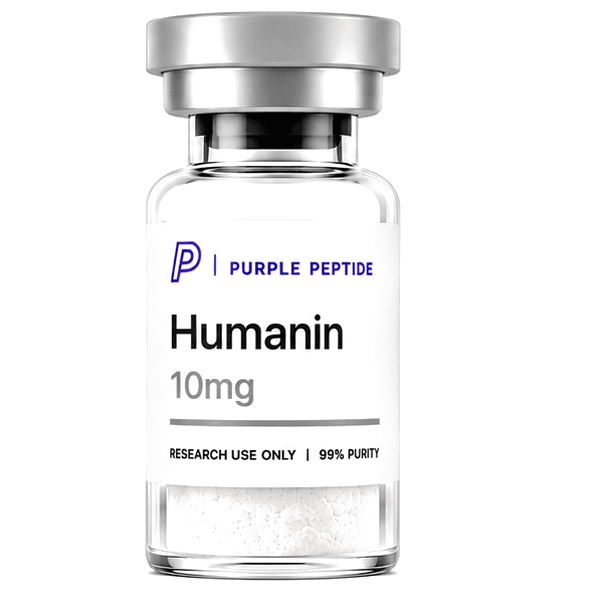
Humanin research vial
Sequence length
24 AA
Molecular weight
2687.2 g/mol
Current batch
HUMAN202602
Mitochondrial · Mitochondrial biology / Cellular stress research

Humanin

24-amino-acid mitochondrial-derived peptide encoded in the 16S rRNA mtDNA region

Out of stock · next batch expected soon
Restocking soon

Get a one-time email when this batch ships.

One email. No marketing. Unsubscribe instantly.

Specifications

Molecular weight2687.2 g/mol
Sequence length24 amino acids
Amino acid sequenceMet-Ala-Pro-Arg-Gly-Phe-Ser-Cys-Leu-Leu-Leu-Leu-Thr-Ser-Glu-Ile-Asp-Leu-Pro-Val-Lys-Arg-Arg-Ala
Molecular formulaC87H138N24O26S2
AppearanceWhite lyophilized powder
SolubilityBacteriostatic water; sterile water
Storage (lyophilized)-20°C, protected from light
Storage (reconstituted)2–8°C, use within 28 days
Half-lifeShort systemic half-life reported in animal models
Current batch purity99.68% (HPLC) · HUMAN202602

Humanin is a 24-amino-acid mitochondrial-derived peptide (MDP) encoded within the 16S rRNA region of mitochondrial DNA. The sequence (MAPRGFSCLLLLTSEIDLPVKRRA) was first identified in 2001 through functional expression screening of a cDNA library from the occipital lobe of an Alzheimer's disease brain. Humanin is studied in vitro and in animal models for its interactions with the IGFBP-3 axis, the trimeric CNTFR/WSX-1/gp130 receptor complex, and the formyl peptide receptor FPR2 (FPRL1). It is supplied by NovaWell as a lyophilized powder, third-party tested for purity and endotoxin conformance, for laboratory research use only.

Research Studies

The following studies are summarized for educational purposes only. Inclusion does not imply any human use; all referenced research was conducted in vitro or in animal models.

Research study

A rescue factor abolishing neuronal cell death by a wide spectrum of familial Alzheimer's disease genes and Abeta

Hashimoto Y, Niikura T, Tajima H, Yasukawa T, Sudo H, Ito Y, Kita Y, Kawasumi M, Kouyama K, Doyu M, Sobue G, Koide T, Tsuji S, Lang J, Kurokawa K, Nishimoto I. Proc Natl Acad Sci USA. 2001;98(11):6336–6341. View source ↗

Scientific findings

This landmark study reported the identification of Humanin (HN), a novel 24-residue peptide isolated via functional expression screening of a cDNA library constructed from the occipital lobe of an Alzheimer's disease brain — a region noted to remain relatively intact in AD. In cultured neuronal cells, Humanin abolished cell death induced by overexpression of multiple familial Alzheimer's disease (FAD) genes (mutant APP, presenilin-1, and presenilin-2) as well as by exogenous amyloid-β (Aβ1–43 and Aβ1–42). The protective effect was observed in the nanomolar range and was sequence-specific: a Cys-to-Ser substitution at position 8 abolished activity, while a Ser-to-Gly substitution at position 14 (HNG) enhanced potency by approximately 1000-fold. The peptide did not protect against insults unrelated to FAD signaling, suggesting a mechanism specific to the AD-associated cell death pathway. This paper established the foundation for the mitochondrial-derived peptide (MDP) family.

Plain English

Scientists were looking for natural factors in the brain that might protect neurons from the damage seen in Alzheimer's disease. They screened a library of genetic material from a brain region that tends to be spared in Alzheimer's patients, and identified a small 24-amino-acid peptide they named Humanin. In a laboratory dish, Humanin rescued nerve cells from death caused by mutant Alzheimer's-related genes and by amyloid-beta — the protein fragment that forms plaques in Alzheimer's brains. The protection was very specific: changing one amino acid eliminated the effect, while a different single-amino-acid swap made it about a thousand times more potent. This was the first description of what is now called the mitochondrial-derived peptide family.

Research study

Interaction between the Alzheimer's survival peptide humanin and insulin-like growth factor-binding protein 3 regulates cell survival and apoptosis

Ikonen M, Liu B, Hashimoto Y, Ma L, Lee KW, Niikura T, Nishimoto I, Cohen P. Proc Natl Acad Sci USA. 2003;100(22):13042–13047. View source ↗

Scientific findings

Using yeast two-hybrid screening with Humanin as bait against a human testis cDNA library, the authors identified insulin-like growth factor binding protein 3 (IGFBP-3) as a direct Humanin-binding partner. The Humanin–IGFBP-3 interaction was confirmed by GST pull-down, surface plasmon resonance, and co-immunoprecipitation. Both proteins were shown to colocalize in human brain tissue. Functionally, Humanin and IGFBP-3 reciprocally modulated each other's effects on cell survival: Humanin attenuated IGFBP-3-induced apoptosis in glioblastoma cells, while IGFBP-3 blocked Humanin's rescue of neuronal cells from FAD-gene-induced death. The work linked the mitochondrial-derived peptide Humanin to the insulin/IGF signaling axis — an axis with well-characterized roles in cellular aging — and was a foundational paper from the Cohen laboratory framing Humanin as a metabolic-aging signal in addition to a cytoprotective factor.

Plain English

Researchers wanted to find out what proteins Humanin physically interacts with inside cells. Using a screening method that pulls binding partners out of a library, they identified IGFBP-3, a protein already known to influence the IGF growth/aging pathway. The two proteins were shown to bind each other directly and to colocalize in human brain tissue. They also influenced each other's effects on cell survival in opposite directions. This study connected Humanin — originally discovered for its rescue of neurons — to the broader insulin and IGF signaling system that has been heavily studied in aging research, helping frame Humanin as both a stress-response peptide and a possible signal in metabolic aging.

Storage & handling

Lyophilized (unreconstituted): Store at -20°C, protected from light. Stable for 24+ months under correct storage. Avoid repeated temperature cycling.

Reconstituted: Dissolve in bacteriostatic water (typically 1–2 mL per 10 mg vial, depending on the research protocol). Store reconstituted solution at 2–8°C and use within 28 days. Do not freeze reconstituted solution.

Vial format: 10 mg lyophilized, vacuum-sealed glass vial with rubber stopper and aluminum crimp. Sterility tested per USP guidelines.

Shipping: Lyophilized Humanin is stable at ambient temperature for the typical 1–3 day shipping window. Cold-pack shipping available on request.

Frequently asked questions

What is Humanin?+

Humanin is a 24-amino-acid mitochondrial-derived peptide (MDP) with the sequence Met-Ala-Pro-Arg-Gly-Phe-Ser-Cys-Leu-Leu-Leu-Leu-Thr-Ser-Glu-Ile-Asp-Leu-Pro-Val-Lys-Arg-Arg-Ala (MAPRGFSCLLLLTSEIDLPVKRRA). Its molecular weight is approximately 2687.2 g/mol and its molecular formula is C87H138N24O26S2. The peptide was first identified by Hashimoto et al. in 2001 through cDNA-library screening from an Alzheimer's-disease brain. Its open reading frame is encoded within the 16S ribosomal RNA region of mitochondrial DNA.

What is a mitochondrial-derived peptide, and how does Humanin relate to MOTS-c?+

Mitochondrial-derived peptides (MDPs) are short bioactive peptides whose coding sequences are embedded within mitochondrial DNA, rather than nuclear DNA. Humanin was the first MDP identified (2001); MOTS-c, encoded within the mitochondrial 12S rRNA region, was the second well-characterized member. Both peptides have been studied in vitro and in animal models as putative signaling molecules from mitochondria to the rest of the cell, with reported effects on metabolic and stress-response pathways. NovaWell offers both Humanin and MOTS-c as separate research-grade lyophilized peptides.

What receptors and binding partners has Humanin been shown to engage in research?+

Published in vitro studies have characterized three principal extracellular interaction surfaces for Humanin: (1) the trimeric receptor complex composed of CNTFR, WSX-1, and gp130, which has been linked to STAT3 signaling; (2) the formyl peptide receptor FPR2 (also called FPRL1), a G-protein-coupled receptor associated with ERK1/2 signaling; and (3) direct binding to insulin-like growth factor binding protein 3 (IGFBP-3), shown by Ikonen et al. 2003. Intracellular interactions with apoptosis-related proteins such as Bax have also been reported in the literature.

What does NovaWell test Humanin for?+

Every batch of Humanin supplied by NovaWell is tested by an independent third-party laboratory for: identity and purity (HPLC + MS), bacterial endotoxin (USP <85>), heavy metals (USP), and sterility (USP). The Certificate of Analysis for the currently shipping batch is linked from the Certificates tab on this page, along with the manufacturer ID and the independent laboratory that performed the analysis.

How should Humanin be stored after reconstitution?+

Once reconstituted in bacteriostatic water, Humanin should be stored at 2–8°C and used within 28 days. Do not freeze reconstituted solution. The lyophilized 10 mg vial is stable at -20°C for 24+ months when protected from light. Humanin contains a cysteine residue (Cys-8) that is functionally important in published assays, so avoid repeated freeze/thaw cycling of the reconstituted solution.

Where does NovaWell source Humanin?+

NovaWell sources Humanin from a vetted synthesis partner under our supplier qualification protocol, which includes facility audits and review of internal QC documentation. Every batch is then independently verified by a third-party laboratory before release. The manufacturer ID for the currently shipping batch is listed in the Description tab on this page.