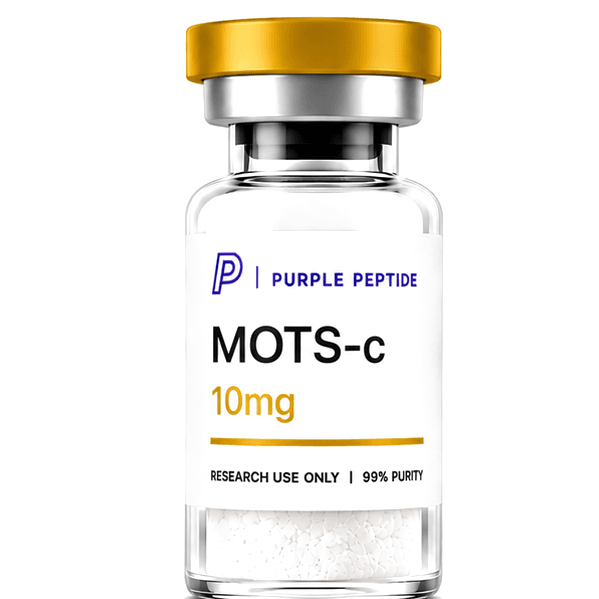
MOTS-c research vial
Sequence length
16 AA
Molecular weight
2174.59 g/mol
Current batch
MOTSC202603
Metabolic · Metabolic / Mitochondrial signaling research

MOTS-c

16-amino-acid mitochondrial-derived peptide encoded in 12S rRNA

MOTS-c (10mg and 40mg vials)

Sign up for verified researcher access to view pricing, see in-stock quantity, and order at member volume tiers (up to 20% off at 20+ vials).

Sign up to view pricing and order.Verified researchers only. Active immediately on sign-up.
Apply for access →

Specifications

Molecular weight2174.59 g/mol
Sequence length16 amino acids
Amino acid sequenceMet-Arg-Trp-Gln-Glu-Met-Gly-Tyr-Ile-Phe-Tyr-Pro-Arg-Lys-Leu-Arg (MRWQEMGYIFYPRKLR)
Molecular formulaC101H152N28O22S2
CAS number1627580-64-6
AppearanceWhite to off-white lyophilized powder
SolubilityBacteriostatic water; sterile water
Storage (lyophilized)-20°C, protected from light
Storage (reconstituted)2–8°C, use within 28 days
Half-lifeShort circulating half-life reported in rodent pharmacokinetic studies
Current batch purity99.11% (HPLC) · MOTSC202603

MOTS-c (Mitochondrial Open-Reading-frame of the Twelve S-rRNA type c) is a 16-amino-acid peptide encoded within the 12S rRNA region of mitochondrial DNA. First characterized by Lee and colleagues in 2015, MOTS-c is one of the founding members of a class of mitochondrial-derived peptides (MDPs) that act as signaling molecules between the mitochondria and the rest of the cell. The peptide has been studied in animal models and cell culture for its effects on AMPK signaling, the folate-methionine one-carbon cycle, and nuclear gene expression under metabolic stress. NovaWell supplies MOTS-c as a lyophilized powder in 10 mg and 40 mg vials, third-party tested for purity and endotoxin conformance, for laboratory research use only.

Research Studies

The following studies are summarized for educational purposes only. Inclusion does not imply any human use; all referenced research was conducted in vitro or in animal models.

Research study

The Mitochondrial-Derived Peptide MOTS-c Promotes Metabolic Homeostasis and Reduces Obesity and Insulin Resistance

Lee C, Zeng J, Drew BG, Sallam T, Martin-Montalvo A, Wan J, Kim SJ, Mehta H, Hevener AL, de Cabo R, Cohen P. Cell Metab. 2015;21(3):443–454. View source ↗

Scientific findings

This is the discovery paper for MOTS-c. The authors identified a short open reading frame within the mitochondrial 12S rRNA that encodes a 16-amino-acid peptide, which they named MOTS-c. In skeletal muscle cell culture, MOTS-c was associated with increased glucose uptake and activation of AMP-activated protein kinase (AMPK). The proposed upstream mechanism was inhibition of the folate cycle, leading to accumulation of the AICAR intermediate — a known direct AMPK agonist. In mouse models, MOTS-c administration was associated with attenuation of high-fat-diet-induced obesity, improved insulin sensitivity on glucose and insulin tolerance testing, and reduced age-dependent insulin resistance. Endogenous circulating MOTS-c was detected in mouse and human plasma, supporting the authors' framing of MOTS-c as a mitochondrially-encoded signaling peptide.

Plain English

Scientists discovered a tiny protein hidden inside a piece of mitochondrial DNA that no one had previously recognized as a gene. They named it MOTS-c. When they tested it in muscle cells, the cells took in more glucose and activated a master energy-sensing switch called AMPK — the same switch that exercise and the diabetes drug metformin flip on. When they gave MOTS-c to mice on a high-fat diet, the mice gained less weight and handled blood sugar better than untreated mice. Older mice also became more responsive to insulin. The discovery was significant because it showed that mitochondria — long thought of as just cellular power plants — also send chemical messages to the rest of the cell.

Research study

The Mitochondrial-Encoded Peptide MOTS-c Translocates to the Nucleus to Regulate Nuclear Gene Expression in Response to Metabolic Stress

Kim KH, Son JM, Benayoun BA, Lee C. Cell Metab. 2018;28(3):516–524.e7. View source ↗

Scientific findings

This follow-up study examined the subcellular trafficking of MOTS-c. Under basal conditions, MOTS-c was detected primarily in the cytoplasm and mitochondria. Under metabolic stress — including glucose restriction and oxidative stress — MOTS-c was reported to translocate to the nucleus. Nuclear MOTS-c was associated with regulation of stress-adaptive nuclear gene expression, including genes involved in antioxidant response and metabolic homeostasis. The authors describe MOTS-c as the first identified mitochondrial-encoded peptide shown to act directly in the nucleus, establishing a direct mitochondrial-to-nuclear signaling axis distinct from classical retrograde signaling.

Plain English

Researchers tracked where MOTS-c goes inside a cell. Under normal conditions it sits mostly in the cell body and within the mitochondria. But when the cell is stressed — for example, when sugar runs low or oxygen-related damage builds up — MOTS-c moves into the cell's nucleus, the compartment that contains the main genome. Once there, it helps switch on genes that the cell uses to handle that stress. This was the first time a peptide encoded by mitochondrial DNA had been observed acting directly on nuclear genes, suggesting a previously unknown communication channel between the two genomes a cell carries.

Storage & handling

Lyophilized (unreconstituted): Store at -20°C, protected from light. Stable for 24+ months under correct storage. Avoid repeated temperature cycling.

Reconstituted: Dissolve in bacteriostatic water (typical reconstitution volumes range from 1–3 mL per 10 mg vial, depending on the research protocol). Store reconstituted solution at 2–8°C and use within 28 days per standard sterile multi-dose vial guidance. Do not freeze reconstituted solution.

Vial formats: 10 mg and 40 mg lyophilized, vacuum-sealed glass vials with rubber stopper and aluminum crimp. Sterility tested per USP guidelines.

Shipping: Lyophilized MOTS-c is stable at ambient temperature for the typical 1–3 day shipping window. Cold-pack shipping available on request.

Frequently asked questions

What is MOTS-c?+

MOTS-c is a 16-amino-acid peptide with the sequence Met-Arg-Trp-Gln-Glu-Met-Gly-Tyr-Ile-Phe-Tyr-Pro-Arg-Lys-Leu-Arg (MRWQEMGYIFYPRKLR) and a molecular weight of approximately 2174.59 g/mol. It was identified and characterized in 2015 by Lee and colleagues and is one of the first described members of the mitochondrial-derived peptide (MDP) family. The molecular formula is C101H152N28O22S2 and the CAS number is 1627580-64-6.

Why is MOTS-c described as 'mitochondrial-derived'?+

Unlike the vast majority of peptides, which are encoded by nuclear DNA, MOTS-c is encoded within the mitochondrial genome — specifically within a short open reading frame inside the 12S ribosomal RNA gene of mitochondrial DNA (mtDNA). This makes it one of a small number of recognized peptides synthesized from instructions stored in mitochondria themselves, and the foundational example of the mitochondrial-derived peptide class described by Cohen and colleagues.

What mechanism has been studied for MOTS-c in animal models?+

The most-studied mechanism in cell culture and animal studies is activation of AMP-activated protein kinase (AMPK), reported to occur via inhibition of the folate-methionine one-carbon cycle and resulting accumulation of the AICAR intermediate, a direct AMPK agonist. AMPK activation is associated downstream with changes in glucose uptake, fatty acid oxidation, and mitochondrial biogenesis pathways. A 2018 follow-up study from the same lab reported that MOTS-c also translocates to the cell nucleus under metabolic stress and is associated with regulation of stress-responsive nuclear gene expression.

What does NovaWell test MOTS-c for?+

Every batch of MOTS-c supplied by NovaWell is tested by an independent third-party laboratory for: identity and purity (HPLC + MS), bacterial endotoxin (USP <85>), heavy metals (USP), and sterility (USP). The Certificate of Analysis for the currently shipping batch is linked from the Certificates tab on this page, along with the test date, manufacturer ID, and the independent laboratory that performed the analysis. Recent batches have tested above 99% pure by HPLC.

What vial sizes does NovaWell offer?+

MOTS-c is supplied in two vial formats: 10 mg lyophilized vials and 40 mg lyophilized vials. The 40 mg vial is offered for researchers running larger or higher-volume protocols and reduces per-milligram cost. Both formats are filled and lyophilized at the same audited synthesis partner facility and undergo identical third-party testing before release.

How should MOTS-c be stored?+

Lyophilized MOTS-c should be stored at -20°C, protected from light, where it is stable for 24+ months. Once reconstituted in bacteriostatic water, MOTS-c should be stored at 2–8°C and used within 28 days per standard sterile multi-dose vial guidance. Do not freeze the reconstituted solution. Lyophilized vials remain stable at ambient temperature for the standard 1–3 day shipping window; cold-pack shipping is available on request.