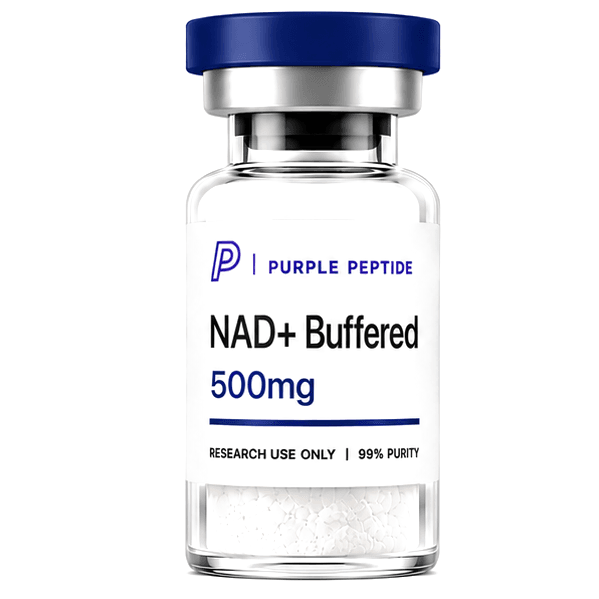
NAD+ research vial
Molecular formula
C21H27N7O14P2
Molecular weight
663.43 g/mol
Current batch
NADPL202604
Mitochondrial · Mitochondrial / NAD+ metabolism research

NAD+

Pyridine dinucleotide coenzyme central to cellular redox and sirtuin biology

NAD+ (750mg vials, Buffered or Unbuffered)

Sign up for verified researcher access to view pricing, see in-stock quantity, and order at member volume tiers (up to 20% off at 20+ vials).

Sign up to view pricing and order.Verified researchers only. Active immediately on sign-up.
Apply for access →

Specifications

Molecular weight663.43 g/mol
Molecular formulaC21H27N7O14P2
Compound classPyridine dinucleotide coenzyme (not a peptide)
VariantsBuffered (pH-adjusted) or Unbuffered (unadjusted)
AppearanceWhite to off-white lyophilized powder
SolubilityBacteriostatic water; sterile water for injection
Storage (lyophilized)-20°C, protected from light
Storage (reconstituted)2–8°C, use within 28 days
Half-lifeShort systemic half-life; rapidly enters cellular salvage pathways
Current batch purity99.54% (HPLC) · NADPL202604

NAD+ (Nicotinamide adenine dinucleotide) is a small-molecule pyridine dinucleotide coenzyme — not a peptide — present in every living cell, where it serves as a central electron carrier in redox reactions and as a substrate for sirtuins, PARPs, and CD38. Its molecular formula is C21H27N7O14P2, with a molecular weight of approximately 663.43 g/mol. NAD+ pools decline with age in many tissues, which has motivated extensive in vitro and in vivo research into NAD+ boosting strategies. NovaWell supplies NAD+ as a lyophilized powder in 750 mg vials, in two variants — Buffered (pH-adjusted for reconstitution tolerability in research settings) and Unbuffered (the unadjusted disodium form). Each batch is third-party tested for identity, purity, and endotoxin conformance, for laboratory research use only.

Research Studies

The following studies are summarized for educational purposes only. Inclusion does not imply any human use; all referenced research was conducted in vitro, in animal models, or in early-phase pharmacokinetic studies.

Research study

Therapeutic Potential of NAD-Boosting Molecules: The In Vivo Evidence

Rajman L, Chwalek K, Sinclair DA. Cell Metabolism. 2018;27(3):529–547. View source ↗

Scientific findings

This widely-cited review synthesizes the in vivo evidence for NAD+ precursors and other NAD+-boosting molecules across animal models of aging and metabolic stress. The authors describe NAD+ as a hub coenzyme that couples redox metabolism (NAD+/NADH balance, ATP generation) to the activity of NAD+-consuming enzymes — particularly the sirtuin deacylases (SIRT1–SIRT7), PARPs, and CD38. The review compiles preclinical data on nicotinamide riboside (NR), nicotinamide mononucleotide (NMN), nicotinic acid, and nicotinamide, summarizing reported effects on mitochondrial function, insulin sensitivity, vascular biology, and neuronal NAD+ pools in rodent models. The authors discuss the age-related decline in tissue NAD+ and the rationale for studying NAD+ repletion as a research target, while noting that translation from animal models to humans requires further controlled study.

Plain English

NAD+ is a small molecule that every cell uses to shuttle electrons during energy production. It also acts as a fuel for a family of enzymes called sirtuins, which scientists study in connection with cellular aging. In animal studies, NAD+ levels drop in many tissues as the animal ages. This review collects the evidence from rodent studies where researchers gave NAD+ precursor molecules to animals and measured what happened to their cells. The authors describe consistent patterns across studies — improvements in mitochondrial measurements, metabolic markers, and stress responses — while emphasizing that these are animal findings and that human research is still in earlier stages.

Research study

Nicotinamide riboside is uniquely and orally bioavailable in mice and humans

Trammell SAJ, Schmidt MS, Weidemann BJ, Redpath P, Jaksch F, Dellinger RW, Li Z, Abel ED, Migaud ME, Brenner C. Nature Communications. 2016;7:12948. View source ↗

Scientific findings

This study reports the first-in-human pharmacokinetic characterization of an NAD+ precursor, nicotinamide riboside (NR), alongside parallel mouse data. In mice, oral NR produced distinct and superior hepatic NAD+ pharmacokinetics compared with equimolar doses of nicotinic acid and nicotinamide. In a clinical pharmacokinetic study, single oral doses of 100, 300, and 1000 mg of NR produced dose-dependent increases in the blood NAD+ metabolome in healthy adults. The authors also identified nicotinic acid adenine dinucleotide (NAAD) as a previously unappreciated metabolite formed from NR, and reported that NAAD elevation is a highly sensitive biomarker of effective NAD+ repletion. The study established that oral NAD+ precursors can elevate the blood NAD+ metabolome in humans in a dose-responsive way, providing a framework for downstream research into NAD+ pool dynamics.

Plain English

Scientists wanted to know whether taking an NAD+ precursor by mouth would actually raise NAD+ levels in the body. They tested a molecule called nicotinamide riboside (NR) in both mice and healthy human volunteers. In mice, NR raised NAD+ in the liver more than two other forms tested. In humans, single oral doses produced dose-dependent increases in NAD+ and related metabolites measured in the blood, with bigger doses producing bigger rises. The researchers also discovered a related molecule, NAAD, that turned out to be a sensitive marker for tracking whether an NAD+ booster was actually working. This study laid the groundwork for measuring NAD+ pool changes in human research.

Storage & handling

Lyophilized (unreconstituted): Store at -20°C, protected from light. Stable for 12+ months under correct storage. Avoid repeated temperature cycling.

Reconstituted: Dissolve in bacteriostatic water (typical reconstitution volume depends on the research protocol and concentration target). Store reconstituted solution at 2–8°C and use within 28 days. Do not freeze reconstituted solution. Protect from light.

Vial format: 750 mg lyophilized, vacuum-sealed glass vial with rubber stopper and aluminum crimp, supplied in Buffered or Unbuffered form. Sterility tested per USP guidelines.

Shipping: Lyophilized NAD+ is stable at ambient temperature for the typical 1–3 day shipping window. Cold-pack shipping available on request.

Frequently asked questions

What is NAD+ and is it a peptide?+

NAD+ (Nicotinamide adenine dinucleotide) is not a peptide. It is a small-molecule pyridine dinucleotide coenzyme composed of two nucleotides — one with an adenine base and one with a nicotinamide base — joined by a phosphate bridge. Its molecular formula is C21H27N7O14P2 with a molecular weight of approximately 663.43 g/mol. NAD+ is supplied here in lyophilized form because, like many research peptides, it is most stable as a dry powder until the researcher is ready to reconstitute it.

What's the difference between Buffered and Unbuffered NAD+?+

Both variants are the same NAD+ molecule. Unbuffered NAD+ is the standard lyophilized disodium NAD+ powder with no pH-adjusting excipients added. Buffered NAD+ is supplied with a pH-adjusting buffer system incorporated into the lyophilized cake, which yields a less acidic reconstituted solution. Some research protocols specify a buffered formulation for tolerability when used in vivo. The active research compound is identical between variants; the choice depends on the researcher's protocol.

What does NovaWell test NAD+ for?+

Every batch of NAD+ supplied by NovaWell — Buffered and Unbuffered alike — is tested by an independent third-party laboratory for: identity and purity (HPLC), bacterial endotoxin (USP <85>), heavy metals (USP), and sterility (USP). The Certificate of Analysis for the currently shipping batch is linked from the Certificates tab on this page. Recent Unbuffered batches have tested above 99.8% pure by HPLC.

How should NAD+ be stored?+

Lyophilized NAD+ is stable at -20°C, protected from light, for 12+ months. After reconstitution in bacteriostatic water, store at 2–8°C, protect from light, and use within 28 days. Do not freeze reconstituted solution. NAD+ in aqueous solution is more sensitive to light and temperature than the lyophilized powder, so reconstituted vials should be kept refrigerated between uses.

What size vials does NovaWell supply NAD+ in?+

NAD+ is supplied in 750 mg lyophilized vials in both Buffered and Unbuffered variants. Multi-vial boxes are available — see the product page for current pack sizes and pricing.

How is NAD+ reconstituted?+

NAD+ is reconstituted in bacteriostatic water. The exact volume depends on the researcher's protocol and target concentration; 750 mg of lyophilized NAD+ is commonly reconstituted in larger volumes than typical research peptides because of the higher mass per vial. Inject the diluent slowly down the side of the vial and allow the cake to dissolve without aggressive agitation. Once reconstituted, store at 2–8°C and protect from light.