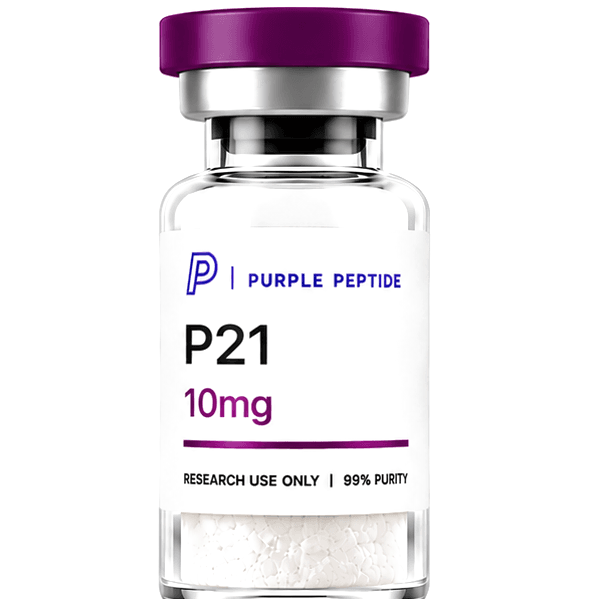
P21 research vial
Sequence length
11 AA
Molecular weight
Approx. 1144 g/mol (11-mer Peptide 6, VGDGGLFEKKL)
Current batch
P21202605
Nootropics · Neurogenesis / Cognitive peptide research

P21

CNTF-derived synthetic peptide studied for hippocampal neurogenesis and memory in rodent models

P21 (10mg vials)

Sign up for verified researcher access to view pricing, see in-stock quantity, and order at member volume tiers (up to 20% off at 20+ vials).

Sign up to view pricing and order.Verified researchers only. Active immediately on sign-up.
Apply for access →

Specifications

Molecular weightApprox. 1144 g/mol (11-mer Peptide 6, VGDGGLFEKKL)
Sequence length11 amino acids
Amino acid sequenceVal-Gly-Asp-Gly-Gly-Leu-Phe-Glu-Lys-Lys-Leu (VGDGGLFEKKL)
AppearanceWhite lyophilized powder
SolubilityBacteriostatic water; sterile water
Storage (lyophilized)-20°C, protected from light
Storage (reconstituted)2–8°C, use within 28 days
Half-lifeApproximately 6 hours in plasma (rodent study, Chohan 2011)
Current batch purity99.44% (HPLC) · P21202605

P21 is the common research-supplier designation for an 11-amino-acid synthetic peptide (sequence Val-Gly-Asp-Gly-Gly-Leu-Phe-Glu-Lys-Lys-Leu, "VGDGGLFEKKL") originally described in the peer-reviewed literature as "Peptide 6." It was designed by Khalid Iqbal and colleagues at the New York State Institute for Basic Research in Developmental Disabilities (Staten Island, NY) as a synthetic fragment from a biologically active region of ciliary neurotrophic factor (CNTF). A further-reduced tetrapeptide derivative from the same lineage — Ac-DGGL, also designated "P021" — is described in later publications from the same group. Researchers evaluating P21 should note that the published English-language literature on Peptide 6 / P021 originates almost entirely from the Iqbal research lineage at IBR and its direct collaborators, and independent replication outside this lineage is limited. The compound has been studied in rodent models for effects on hippocampal neurogenesis, BDNF expression, leukemia inhibitory factor (LIF) signaling, and memory tasks. P21 is supplied by NovaWell as a lyophilized powder, third-party tested for purity and endotoxin conformance, for laboratory research use only.

Research Studies

The following studies are summarized for educational purposes only. Inclusion does not imply any human use; all referenced research was conducted in vitro or in animal models. Researchers should note that both citations below originate from the same research lineage (Iqbal group, New York State Institute for Basic Research in Developmental Disabilities) — a factual context relevant when evaluating the breadth of independent evidence.

Research study

Enhancement of dentate gyrus neurogenesis, dendritic and synaptic plasticity and memory by a neurotrophic peptide

Chohan MO, Li B, Blanchard J, Tung YC, Heaney AT, Rabe A, Iqbal K, Grundke-Iqbal I. Neurobiol Aging. 2011 Aug;32(8):1420–1434. View source ↗

Scientific findings

This paper reports the design and initial in vivo characterization of the 11-mer synthetic peptide "Peptide 6," derived from a biologically active region of ciliary neurotrophic factor (CNTF). In adult C57BL/6 mice, peripherally administered Peptide 6 induced proliferation of neural progenitor cells and increased survival and maturation of newly-born neurons in the dentate gyrus, as quantified by BrdU incorporation and double-labeling for neuronal markers. The peptide also increased MAP2 and synaptophysin immunoreactivity in the dentate gyrus, consistent with enhanced dendritic and synaptic markers. A 30-day subcutaneous slow-release implant produced improved reference memory in the Morris water maze. The authors reported a plasma half-life of approximately 6 hours and described the peptide as blood-brain-barrier permeable, with a proposed mechanism of competitive inhibition of leukemia inhibitory factor (LIF) signaling. This is the foundational publication on the Peptide 6 / P21 lineage and was conducted by the originating research group at the New York State Institute for Basic Research in Developmental Disabilities.

Plain English

Researchers wanted a small synthetic peptide that could copy part of what a natural growth factor for neurons (CNTF) does, but be small enough to cross from the bloodstream into the brain. They designed an 11-amino-acid peptide they called "Peptide 6" based on a piece of CNTF. When normal adult mice received the peptide under the skin for thirty days using a slow-release implant, the researchers observed more new neurons being born and surviving in a memory-related part of the brain called the dentate gyrus. The mice also performed better on a standard rodent memory test (the Morris water maze). The peptide stayed in the blood for about six hours and appeared to act by blocking a signal called LIF that normally slows neurogenesis. This is the founding study that defined the Peptide 6 / P21 family — it was carried out by the same lab that originally designed the molecule.

Research study

Prevention of dendritic and synaptic deficits and cognitive impairment with a neurotrophic compound

Bolognin S, Buffelli M, Puoliväli J, Iqbal K. Alzheimers Res Ther. 2014 Mar 6;6(2):19. (Re-indexed in PMC PMC5488423) View source ↗

Scientific findings

This study evaluated the tetrapeptide derivative P021 (Ac-DGGL) — a smaller analogue from the same Peptide 6 / P21 lineage — in the 3xTg-AD mouse model of Alzheimer's-type pathology. The authors reported that chronic oral administration of P021 in mice rescued deficits in dendritic and synaptic markers, supported hippocampal neurogenesis, and was associated with improved performance on cognitive tasks compared with vehicle-treated transgenic controls. The authors interpreted the findings as consistent with the proposed mechanism of LIF inhibition and increased BDNF expression described in the original Chohan et al. (2011) work. As with the foundational paper, this study originates from the Iqbal research lineage at the New York State Institute for Basic Research in Developmental Disabilities, and the same group has produced most of the follow-up rodent literature on this peptide family.

Plain English

Researchers tested a smaller, more drug-like version of the original Peptide 6 — called P021 — in a mouse model that develops brain changes similar to Alzheimer's disease. The mice received the peptide by mouth over time. Compared with untreated mice from the same Alzheimer-model strain, the treated mice showed better-preserved connections between brain cells, more new neurons forming in the hippocampus, and better performance on memory tasks. The authors interpreted this as further evidence for the same mechanism the lab described in 2011 — blocking the LIF signal and raising BDNF. The work was done by the same research lineage that introduced the peptide, so independent replication by unrelated laboratories remains the key gap in the evidence base.

A note on the research base

The published primary literature on Peptide 6 / P021 (often sold under the name "P21") originates from a single research lineage — Khalid Iqbal and colleagues at the New York State Institute for Basic Research in Developmental Disabilities, plus direct collaborators. Independent replication of the core findings by unrelated laboratories is limited in the indexed Western literature, and there are no controlled human efficacy data on this peptide in PubMed-indexed Western journals. The peptide is not approved by the FDA, EMA, or any major national regulatory body for any indication. Researchers should weigh the published evidence in that context.

Storage & handling

Lyophilized (unreconstituted): Store at -20°C, protected from light. Stable for 24+ months under correct storage. Avoid repeated temperature cycling.

Reconstituted: Dissolve in bacteriostatic water (typically 1–2 mL per 10 mg vial, depending on the research protocol). Store reconstituted solution at 2–8°C and use within 28 days. Do not freeze reconstituted solution.

Vial format: 10 mg lyophilized, vacuum-sealed glass vial with rubber stopper and aluminum crimp. Sterility tested per USP guidelines.

Shipping: Lyophilized P21 is stable at ambient temperature for the typical 1–3 day shipping window. Cold-pack shipping available on request.

Frequently asked questions

What peptide is P21?+

"P21" is the common research-supplier name for an 11-amino-acid synthetic peptide with the sequence Val-Gly-Asp-Gly-Gly-Leu-Phe-Glu-Lys-Lys-Leu (VGDGGLFEKKL). In the peer-reviewed literature it was originally described as "Peptide 6" by Chohan and colleagues in 2011 (PMID 19767127). The same research group later published on a shorter tetrapeptide derivative from the same lineage, Ac-DGGL, designated "P021." Suppliers in the research-peptide market use the name "P21" inconsistently — it usually refers to the 11-mer Peptide 6, but some catalogs use it for the P021 tetrapeptide. NovaWell ships the 11-mer (VGDGGLFEKKL) sequence; the identity of each shipped batch is confirmed by HPLC and mass spectrometry on the linked Certificate of Analysis.

How is P21 derived from CNTF?+

Ciliary neurotrophic factor (CNTF) is a naturally occurring protein that supports the survival and growth of certain types of neurons. The Iqbal group at the New York State Institute for Basic Research in Developmental Disabilities identified a short region of the CNTF protein that they proposed retained biological activity, and synthesized the 11-mer peptide (VGDGGLFEKKL) from that region as a small-molecule mimetic. The design goal was a compound small enough to cross the blood-brain barrier and resist enzymatic degradation while still producing some of the neurotrophic and neurogenic signaling effects associated with CNTF. The reduction strategy is described in detail in the foundational Chohan et al. 2011 paper.

What is the proposed mechanism of P21?+

Based on the Chohan et al. (2011) work and follow-up publications from the same research lineage, the proposed mechanism has two components. First, P21 / Peptide 6 is described as competitively inhibiting leukemia inhibitory factor (LIF) signaling, which normally restrains adult hippocampal neurogenesis — removing that restraint allows more new neurons to be born and to mature. Second, the peptide is associated with increased expression of brain-derived neurotrophic factor (BDNF), which supports dendritic and synaptic markers. Both effects were reported in normal adult mice and, separately, in rodent models of Alzheimer-type pathology. These mechanistic interpretations come from the originating laboratory and have not been confirmed by independent structural-biology work outside that lineage.

What are the limitations of the P21 research literature?+

Researchers evaluating P21 should be aware that the published English-language primary literature on this peptide family originates almost entirely from one research lineage — Khalid Iqbal and colleagues at the New York State Institute for Basic Research in Developmental Disabilities — and their direct collaborators. Independent replication by unrelated laboratories is limited in the indexed Western literature. The published evidence is preclinical: rodent in vivo studies and supporting in vitro work. There are no controlled human efficacy data on P21 / Peptide 6 / P021 in PubMed-indexed Western journals. The peptide is not approved by the FDA, EMA, or any major national regulatory body for any indication, and the name "P21" is also used in unrelated contexts in molecular biology (most commonly the cell-cycle protein p21/CDKN1A) — these are different molecules and should not be confused.

What does NovaWell test P21 for?+

Every batch of P21 supplied by NovaWell is tested by an independent third-party laboratory for: identity and purity (HPLC + MS), bacterial endotoxin (USP <85>), heavy metals (USP), and sterility (USP). The Certificate of Analysis for the currently shipping batch is linked from the Certificates tab on this page, along with the test date, manufacturer ID, and the independent laboratory that performed the analysis. Because the name "P21" is used inconsistently across the research-peptide market, the CoA also confirms the exact synthesized sequence by mass spectrometry.

How should P21 be stored after reconstitution?+

Once reconstituted in bacteriostatic water, P21 should be stored at 2–8°C and used within 28 days. Do not freeze reconstituted solution. The lyophilized 10 mg vial is stable at -20°C for 24+ months when kept protected from light and free from repeated temperature cycling.