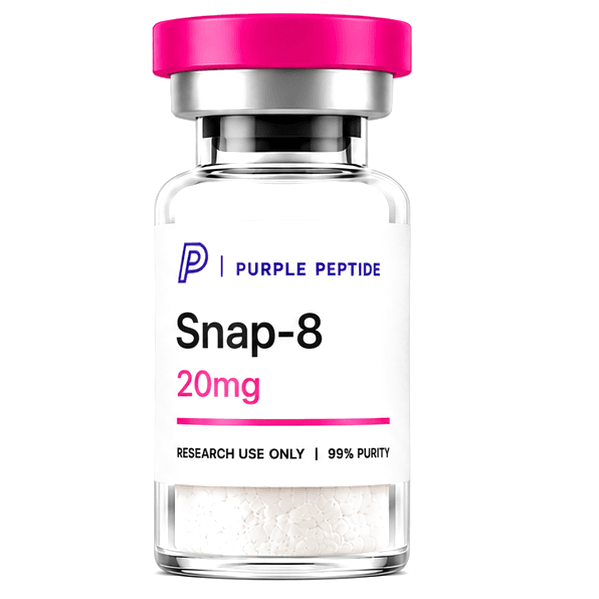
Snap-8 research vial
Sequence length
8 AA
Molecular weight
1075.16 g/mol
Current batch
SNAP8202601
Dermal · Topical cosmetic peptide / Dermal research

Snap-8

N-acetylated octapeptide derived from the N-terminus of SNAP-25

Snap-8 (10mg vials)

Sign up for verified researcher access to view pricing, see in-stock quantity, and order at member volume tiers (up to 20% off at 20+ vials).

Sign up to view pricing and order.Verified researchers only. Active immediately on sign-up.
Apply for access →

Specifications

Molecular weight1075.16 g/mol
Sequence length8 amino acids
Amino acid sequenceAc-Glu-Glu-Met-Gln-Arg-Arg-Ala-Asp-NH2
Molecular formulaC41H70N16O16S
AppearanceWhite lyophilized powder
SolubilityBacteriostatic water; sterile water
Storage (lyophilized)-20°C, protected from light
Storage (reconstituted)2–8°C, use within 28 days
Current batch purity99.41% (HPLC) · SNAP8202601

Snap-8 (Acetyl Octapeptide-3, also called Argireline-8 or SNAP-8) is a synthetic N-acetylated 8-amino-acid peptide patterned after the N-terminal end of SNAP-25 (synaptosomal-associated protein 25), an essential component of the SNARE complex involved in calcium-dependent neurotransmitter exocytosis. Snap-8 is the 8-amino-acid extended analogue of the more widely documented hexapeptide Argireline (Acetyl Hexapeptide-3 / Acetyl Hexapeptide-8). It is studied as a topical cosmetic ingredient for its in vitro effects on the SNARE assembly pathway at the neuromuscular junction. NovaWell supplies Snap-8 as a lyophilized white powder in 10 mg vials, third-party tested for purity, endotoxin, and sterility, for laboratory research use only.

Research Studies

The following studies are summarized for educational purposes only. Inclusion does not imply any human use; all referenced research was conducted in vitro, in cellular models, or in topical cosmetic-formulation settings.

Research study

A synthetic hexapeptide (Argireline) with antiwrinkle activity

Blanes-Mira C, Clemente J, Jodas G, Gil A, Fernández-Ballester G, Ponsati B, Gutierrez L, Pérez-Payá E, Ferrer-Montiel A. Int J Cosmet Sci. 2002;24(5):303–310. View source ↗

Scientific findings

This foundational paper characterizes the parent hexapeptide of the Snap-8 family — Argireline (Ac-Glu-Glu-Met-Gln-Arg-Arg-NH2) — designed as a structural mimic of the N-terminal domain of SNAP-25. Using cell-free SNARE complex assembly assays and bovine adrenal chromaffin cells, the authors showed that the hexapeptide interferes with the formation and/or stability of the ternary SNARE complex required for Ca²⁺-dependent exocytosis, and reduces catecholamine release in a concentration-dependent manner. In an in vivo topical study on healthy adult volunteers, an oil/water emulsion formulation containing the hexapeptide reduced periorbital wrinkle depth by approximately 30% over 30 days of twice-daily application, measured by skin topography. The peptide showed no acute oral toxicity at high doses and no primary skin irritation in standard dermal safety assays. Snap-8 is the 8-residue C-terminal extension of this molecule (adding Ala-Asp to the parent sequence) and is designed to occupy the same N-terminal mimetic binding site within the SNARE assembly.

Plain English

Researchers designed a short peptide patterned after a small piece of a protein called SNAP-25, which nerves use to fire signals to muscles. In lab dishes, the peptide got in the way of the molecular "Velcro" that nerves use to release their chemical signals. In a topical cream applied to volunteers' faces for 30 days, expression-line depth dropped by about 30%. The peptide caused no irritation in standard skin tests. Snap-8 is a slightly longer version of this same molecule — two extra amino acids tacked on — and is designed to bind in the same place.

Research study

Acetyl Hexapeptide-8 in Cosmeceuticals—A Review of Skin Permeability and Efficacy

Zdrada-Nowak J, Surgiel-Gemza A, Szatkowska M. Int J Mol Sci. 2025;26(12):5722. View source ↗

Scientific findings

This 2025 peer-reviewed literature review consolidates the mechanism, in vitro permeation, and topical efficacy data for the acetyl hexapeptide family, including Acetyl Hexapeptide-3/8 (Argireline) and its 8-residue analogue Acetyl Octapeptide-3 (Snap-8). The review describes the shared mechanism: both peptides are designed to mimic the N-terminus of SNAP-25, competing with native SNAP-25 for binding to vesicle-associated membrane protein (VAMP) and syntaxin, thereby destabilizing SNARE complex assembly and reducing calcium-dependent acetylcholine release at the neuromuscular junction. The authors summarize in vitro Franz-cell skin-permeation data showing that the high molecular weight (>1000 g/mol) and zwitterionic character of these peptides limits passive stratum corneum penetration, and review formulation strategies — including liposomal, ethosomal, and microneedle-assisted vehicles — used to enhance dermal delivery. Reported topical efficacy in published cosmetic studies for the acetyl hexapeptide/octapeptide class includes wrinkle-depth reductions in the 17–48% range over 28–30 days of twice-daily application at typical 3–10% formulation concentrations, with the octapeptide analogue (Snap-8) reported in manufacturer-sponsored studies as moderately more potent per-mole than the hexapeptide.

Plain English

Scientists summarized everything published on the family of peptides that includes Snap-8 and its shorter cousin Argireline. Both peptides work the same way: they jam the molecular machinery that nerves use to fire signals to facial muscles, so the muscles contract less. The catch is that these peptides are large and water-loving, which makes it hard for them to cross the outer skin barrier on their own. The review covers the formulation tricks — special carriers, microneedle patches — that researchers use to get the peptides into the skin. Across published studies, topical formulations of these peptides have been associated with measurable reductions in expression-line depth over four weeks of consistent application.

Storage & handling

Lyophilized (unreconstituted): Store at -20°C, protected from light. The lyophilized powder is stable for 24+ months under correct storage. Avoid repeated temperature cycling.

Reconstituted: Dissolve in bacteriostatic water (typically 1–3 mL per 10 mg vial, depending on the research formulation). Store reconstituted solution at 2–8°C and use within 28 days. Avoid freeze-thaw cycles.

Vial format: 10 mg lyophilized, vacuum-sealed glass vial with rubber stopper and aluminum crimp. Sterility tested per USP guidelines.

Shipping: Lyophilized Snap-8 is stable at ambient temperature for the typical 1–3 day shipping window. Cold-pack shipping available on request.

Frequently asked questions

What is Snap-8?+

Snap-8 is Acetyl Octapeptide-3 — a synthetic 8-amino-acid peptide with the sequence Ac-Glu-Glu-Met-Gln-Arg-Arg-Ala-Asp-NH2 (N-terminal acetyl, C-terminal amide), molecular weight 1075.16 g/mol, molecular formula C41H70N16O16S. It is patterned after the N-terminal end of SNAP-25 and is studied as a topical cosmetic peptide for in vitro effects on the SNARE assembly pathway.

How is Snap-8 different from Argireline (Acetyl Hexapeptide-3)?+

Argireline (Acetyl Hexapeptide-3, also marketed as Acetyl Hexapeptide-8) is the 6-residue parent sequence Ac-Glu-Glu-Met-Gln-Arg-Arg-NH2. Snap-8 extends that sequence at the C-terminus by two amino acids — Ala-Asp — yielding the 8-residue Ac-Glu-Glu-Met-Gln-Arg-Arg-Ala-Asp-NH2. Both peptides share the same proposed mechanism (mimicry of the N-terminal end of SNAP-25 and competition for SNARE complex assembly). The Argireline literature is significantly more developed; the Snap-8 literature is largely manufacturer-sponsored and review-level.

What is the SNAP-25 / SNARE mechanism?+

SNAP-25 (synaptosomal-associated protein 25) is one of three proteins that assemble into the SNARE complex — the molecular machinery that fuses neurotransmitter-containing vesicles with the presynaptic membrane in response to a calcium signal. At the neuromuscular junction, this fusion releases acetylcholine, which triggers muscle contraction. Snap-8 and Argireline are designed to mimic the N-terminal end of SNAP-25 and compete with native SNAP-25 for binding partners (VAMP and syntaxin), destabilizing SNARE assembly in vitro and reducing exocytosis in cellular assays.

Is Snap-8 used topically or by injection?+

Snap-8 is studied exclusively as a topical cosmetic research peptide. It is not approved by FDA, EMA, or any other regulator for injection or systemic administration. Published cosmetic formulation research uses Snap-8 at 3–10% concentrations in oil/water emulsions, ethosomes, or microneedle-assisted vehicles for in vitro skin-permeation and topographical studies. Botulinum toxin (Botox), by contrast, is a regulated injectable drug with a distinct mechanism (enzymatic cleavage of SNAP-25 rather than competitive binding).

What does NovaWell test Snap-8 for?+

Every batch of Snap-8 supplied by NovaWell is tested by an independent third-party laboratory for: identity and purity (HPLC + MS), bacterial endotoxin (USP <85>), heavy metals (USP), and sterility (USP). The Certificate of Analysis for the currently shipping batch is linked from the Certificates tab on this page.

How should Snap-8 be stored?+

Lyophilized Snap-8 should be stored at -20°C, protected from light, and is stable for 24+ months under correct storage. Once reconstituted in bacteriostatic water, store at 2–8°C and use within 28 days. Do not freeze the reconstituted solution and avoid repeated freeze-thaw cycles. Lyophilized Snap-8 is stable at ambient temperature for the standard 1–3 day shipping window.