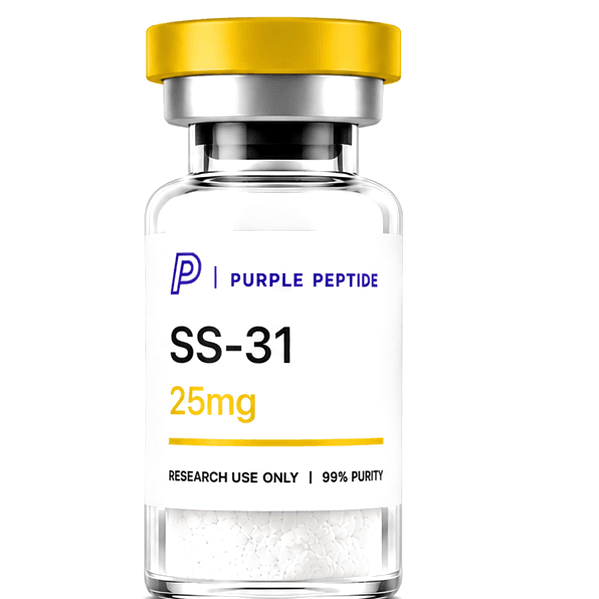
SS-31 research vial
Sequence length
4 AA
Molecular weight
639.78 g/mol
Current batch
SS31202605
Mitochondrial · Mitochondrial bioenergetics / Cardiolipin research

SS-31

Mitochondrial-targeted tetrapeptide that binds cardiolipin

SS-31 (10mg and 50mg vials)

Sign up for verified researcher access to view pricing, see in-stock quantity, and order at member volume tiers (up to 20% off at 20+ vials).

Sign up to view pricing and order.Verified researchers only. Active immediately on sign-up.
Apply for access →

Specifications

Molecular weight639.78 g/mol
Sequence length4 amino acids
Amino acid sequenceD-Arg-Dmt-Lys-Phe-NH2
AppearanceWhite lyophilized powder
SolubilityBacteriostatic water; sterile water
Storage (lyophilized)-20°C, protected from light
Storage (reconstituted)2–8°C, use within 28 days
Half-lifeApproximately 2–3 hours systemic; concentrates in inner mitochondrial membrane
Current batch purity99.23% (HPLC) · SS31202605

SS-31 (also known as Elamipretide, Bendavia, or MTP-131) is a synthetic mitochondrial-targeted tetrapeptide with the sequence D-Arg-Dmt-Lys-Phe-NH2, where Dmt is the non-natural amino acid 2,6-dimethyltyrosine. The alternating cationic-aromatic motif allows the peptide to cross the outer mitochondrial membrane and concentrate at the inner mitochondrial membrane independently of membrane potential, where it binds selectively to cardiolipin — the signature phospholipid of the inner membrane. SS-31 is supplied by NovaWell as a lyophilized powder in 10mg and 50mg vial formats, third-party tested for purity and endotoxin conformance, for laboratory research use only.

Research Studies

The following studies are summarized for educational purposes only. Inclusion does not imply any human use; all referenced research was conducted in vitro, in animal models, or in regulated clinical trials.

Research study

First-in-class cardiolipin-protective compound as a therapeutic agent to restore mitochondrial bioenergetics

Szeto HH. Br J Pharmacol. 2014;171(8):2029–2050. View source ↗

Scientific findings

This foundational review by Hazel Szeto summarizes the design rationale and mechanism of the Szeto-Schiller (SS) peptide family, with SS-31 (D-Arg-Dmt-Lys-Phe-NH2) characterized in detail. The alternating positive-charge / aromatic-residue motif drives a membrane-potential-independent accumulation in the inner mitochondrial membrane, where SS-31 binds selectively to cardiolipin through a combination of electrostatic and hydrophobic interactions. By associating with cardiolipin, SS-31 stabilizes the cytochrome c–cardiolipin complex, suppresses the peroxidase activity that cardiolipin can otherwise impart to cytochrome c under stress, and preserves the structure of mitochondrial cristae. Downstream, the review summarizes in vitro and animal-model data showing preserved electron transport chain assembly, restored ATP synthesis, and reduced reactive oxygen species under conditions of mitochondrial stress.

Plain English

Mitochondria are the parts of a cell that generate energy. Their inner membrane contains a special fat called cardiolipin that holds the energy-generating machinery in the right shape. When mitochondria are stressed, cardiolipin can start damaging the very proteins it normally supports. SS-31 acts like a protective patch — it sticks to cardiolipin, keeps the energy machinery properly assembled, and reduces the damaging side reactions. This 2014 paper by Dr. Szeto, who originally designed the peptide, lays out how SS-31 works and why it was the first compound of its kind.

Research study

The mitochondrial-targeted compound SS-31 re-energizes ischemic mitochondria by interacting with cardiolipin

Birk AV, Liu S, Soong Y, Mills W, Singh P, Warren JD, Seshan SV, Pardee JD, Szeto HH. J Am Soc Nephrol. 2013;24(8):1250–1261. View source ↗

Scientific findings

This study examined SS-31 in models of ischemia and reperfusion injury, where mitochondria are damaged by oxygen deprivation followed by re-oxygenation. Using isolated mitochondria, the authors demonstrated direct binding of SS-31 to cardiolipin and showed that SS-31 preserved the architecture of cristae after ischemic insult. In an in vivo rat model of renal ischemia/reperfusion, SS-31 administration was associated with restored ATP production, preserved respiratory chain supercomplex assembly, and reduced markers of oxidative damage. The authors propose that SS-31's protective effect derives from its ability to dock onto cardiolipin and shield the electron transport chain from the cycle of oxidative damage that follows ischemia.

Plain English

When tissue loses blood flow and then gets it back — for example during a heart attack or kidney injury — the sudden return of oxygen can paradoxically damage mitochondria. The damaged mitochondria then leak harmful molecules and fail to produce energy. In this study, researchers showed that SS-31 binds to cardiolipin in the inner mitochondrial membrane and helps keep the energy-generating chain intact during this stress. In a rat kidney model, mitochondria from animals given SS-31 were able to make ATP again much faster than untreated controls. This work helped support translational interest in SS-31 for ischemia-related research.

Storage & handling

Lyophilized (unreconstituted): Store at -20°C, protected from light. Stable for 24+ months under correct storage. Avoid repeated temperature cycling.

Reconstituted: Dissolve in bacteriostatic water (typical volumes: 1–2 mL per 10 mg vial; 3–5 mL per 50 mg vial, depending on the research protocol). Store reconstituted solution at 2–8°C and use within 28 days. Do not freeze reconstituted solution.

Vial format: 10 mg or 50 mg lyophilized, vacuum-sealed glass vial with rubber stopper and aluminum crimp. Sterility tested per USP guidelines.

Shipping: Lyophilized SS-31 is stable at ambient temperature for the typical 1–3 day shipping window. Cold-pack shipping available on request.

Frequently asked questions

What is SS-31 (Elamipretide)?+

SS-31 is a synthetic mitochondrial-targeted tetrapeptide originally developed by Dr. Hazel Szeto and Dr. Peter Schiller (the "SS" in the name refers to Szeto-Schiller). In clinical-trial settings it has also been called Elamipretide, Bendavia, and MTP-131. It is one of the most extensively studied mitochondrial-targeted peptides, with a published record spanning in vitro biochemistry, animal models of ischemia and neurodegeneration, and registered clinical trials in primary mitochondrial myopathy, Barth syndrome, and heart failure.

How does SS-31 interact with cardiolipin?+

SS-31's alternating cationic / aromatic residue pattern (D-Arg, Dmt, Lys, Phe) drives membrane-potential-independent accumulation at the inner mitochondrial membrane. There, SS-31 binds selectively to cardiolipin — the four-tailed phospholipid that is concentrated at cristae junctions and that holds the electron transport chain in its functional supercomplex arrangement. By binding cardiolipin, SS-31 has been shown in cell-free and in vitro systems to stabilize the cytochrome c–cardiolipin complex, suppress the peroxidase side reaction that damages mitochondria under stress, and preserve cristae structure.

What is the sequence and molecular weight of SS-31?+

SS-31 is the tetrapeptide D-Arg-Dmt-Lys-Phe-NH2, where Dmt is the non-natural amino acid 2,6-dimethyltyrosine. The molecular formula is C32H49N9O5 and the molecular weight is approximately 639.78 g/mol. The C-terminal amide and D-arginine at the N-terminus together contribute to the peptide's enhanced metabolic stability compared with a standard L-amino-acid tetrapeptide.

What does NovaWell test SS-31 for?+

Every batch of SS-31 supplied by NovaWell is tested by an independent third-party laboratory for: identity and purity (HPLC + MS), bacterial endotoxin (USP <85>), heavy metals (USP), and sterility (USP). The Certificate of Analysis for the currently shipping batch is linked from the Certificates tab on this page, along with the batch ID, test date, and the name of the independent laboratory that performed the analysis. Recent batches have tested above 99% pure by HPLC.

Which vial sizes are available?+

NovaWell stocks SS-31 in two lyophilized vial formats: a 10 mg vial for smaller-scale research and a 50 mg vial for laboratories running larger experiments or longer protocols. Both formats ship as vacuum-sealed glass vials with rubber stoppers and aluminum crimps, drawn from the same qualified synthesis batch with the same Certificate of Analysis.

How should SS-31 be stored after reconstitution?+

Lyophilized SS-31 is stable at -20°C, protected from light, for 24+ months. Once reconstituted in bacteriostatic water, SS-31 should be stored at 2–8°C and used within 28 days. Do not freeze reconstituted solution. Lyophilized vials are stable at ambient temperature for the typical 1–3 day shipping window; cold-pack shipping is available on request.