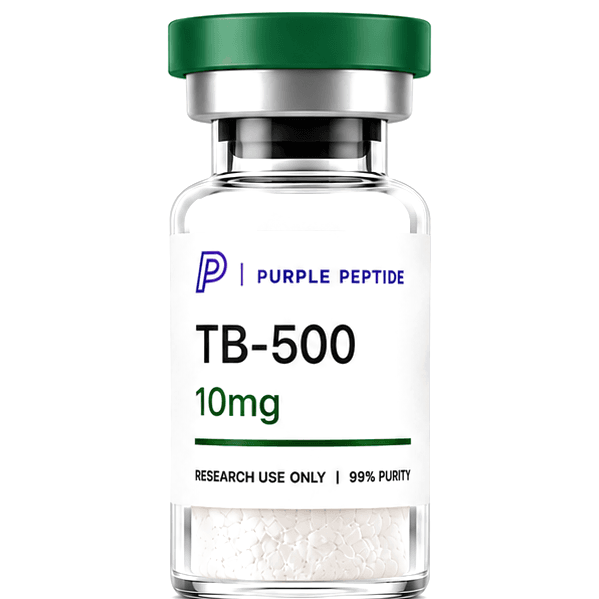
TB-500 (Thymosin Beta-4) research vial
Sequence length
43 AA
Molecular weight
~4963 g/mol
Current batch
TB500202604
Regenerative · Regenerative / Actin sequestration and cell migration research

TB-500 (Thymosin Beta-4)

Full-length 43-amino-acid Thymosin Beta-4 peptide

TB-500 (TB4, 10mg vials)

Sign up for verified researcher access to view pricing, see in-stock quantity, and order at member volume tiers (up to 20% off at 20+ vials).

Sign up to view pricing and order.Verified researchers only. Active immediately on sign-up.
Apply for access →

Specifications

Molecular weight~4963 g/mol
Sequence length43 amino acids
Amino acid sequenceSDKPDMAEIEKFDKSKLKKTETQEKNPLPSKETIEQEKQAGES
AppearanceWhite lyophilized powder
SolubilityBacteriostatic water; sterile water
Storage (lyophilized)-20°C, protected from light
Storage (reconstituted)2–8°C, use within 28 days
Current batch purity99.84% (HPLC) · TB500202604

TB-500 is the synthetic, full-length form of Thymosin Beta-4 (Tβ4), a 43-amino-acid peptide that functions as the major intracellular G-actin sequestering protein in mammalian cells. Tβ4 is widely studied in vitro and in animal models for roles in cell migration, angiogenesis, and tissue repair. NovaWell supplies TB-500 as a lyophilized powder in 10 mg vials, third-party tested for purity, endotoxin, and sterility, for laboratory research use only.

Research Studies

The following studies are summarized for educational purposes only.

Research study

Thymosin β4: a multi-functional regenerative peptide. Indications for use in clinical trials

Goldstein AL, Hannappel E, Sosne G, Kleinman HK. Expert Opin Biol Ther. 2012;12(1):37–51. View source ↗

Scientific findings

This review synthesizes the molecular biology of Thymosin Beta-4 and its observed activities in preclinical models. The authors describe Tβ4's primary intracellular role as a G-actin sequestering protein that regulates cytoskeletal dynamics, and its secreted activities including modulation of stem and progenitor cell migration, angiogenesis via VEGF and laminin pathways, and downregulation of pro-inflammatory cytokines. The review summarizes preclinical evidence across dermal, corneal, cardiac, and central nervous system injury models, where systemic or topical Tβ4 administration was associated with accelerated repair and reduced inflammatory infiltrate.

Plain English

Researchers reviewed everything known at the time about Thymosin Beta-4 — the peptide that TB-500 is the synthetic version of. Inside cells, it acts like a manager that organizes the cell's internal scaffolding. When it's released outside the cell, it appears to help wound healing in multiple ways: it helps stem cells move to where they're needed, helps new blood vessels form, and quiets the inflammation signals that can slow repair. Animal studies in skin, eye, heart, and brain injury models all showed signs of faster recovery when Tβ4 was given.

Research study

Thymosin beta4 induces adult epicardial progenitor mobilization and neovascularization

Smart N, Risebro CA, Melville AA, Moses K, Schwartz RJ, Chien KR, Riley PR. Nature. 2007;445(7124):177–82. View source ↗

Scientific findings

Using genetic lineage tracing in adult mice, the authors demonstrated that Thymosin Beta-4 administration mobilized quiescent epicardium-derived progenitor cells, inducing their proliferation, migration into the myocardium, and differentiation toward endothelial fates. The result was increased capillary density in regions of cardiac injury. The effect required functional Tβ4 and was associated with restoration of pluripotency markers in adult epicardial cells, suggesting that Tβ4 reactivates a developmental program normally dormant in adult tissue.

Plain English

Scientists studied how Thymosin Beta-4 affects the outer layer of the heart in adult mice. They found that the peptide woke up sleeping stem-like cells in this layer, made them divide, and prompted them to migrate into damaged heart tissue where they started forming new blood vessels. In effect, Tβ4 seemed to switch on a repair program that the adult heart had stopped using since development.

Storage & handling

Lyophilized: Store at -20°C, protected from light. Stable for 24+ months.

Reconstituted: Bacteriostatic water (typically 1–2 mL per 10 mg vial). Store at 2–8°C and use within 28 days. Do not freeze reconstituted solution.

Vial format: 10 mg lyophilized, vacuum-sealed glass vial with rubber stopper and aluminum crimp.

Shipping: Lyophilized TB-500 is stable at ambient temperature for the 1–3 day shipping window. Cold-pack shipping available on request.

Frequently asked questions

What is the difference between TB-500 and Thymosin Beta-4?+

"TB-500" is the common research-market name for synthetic, full-length Thymosin Beta-4. Some early literature describes a shorter active fragment of Tβ4, but the material supplied by NovaWell is the full 43-amino-acid sequence. The displayed name "TB4" in the product title reflects this.

What is the peptide sequence?+

The sequence is SDKPDMAEIEKFDKSKLKKTETQEKNPLPSKETIEQEKQAGES — 43 amino acids, approximately 4963 g/mol. It is the same sequence as endogenous Thymosin Beta-4.

What does NovaWell test TB-500 for?+

Identity and purity by HPLC and mass spectrometry, bacterial endotoxin per USP <85>, heavy metals per USP, and sterility per USP. The Certificate of Analysis for the currently shipping batch is in the Certificates tab.

Is TB-500 stable at room temperature during shipping?+

Yes — lyophilized TB-500 is stable at ambient temperature for the typical 1–3 day shipping window. Long-term storage of the lyophilized powder should be at -20°C.

How is TB-500 typically reconstituted in research protocols?+

Researchers typically reconstitute TB-500 with bacteriostatic water at a ratio appropriate for their protocol (commonly 1–2 mL per 10 mg vial). The reconstituted solution should be stored refrigerated at 2–8°C and used within 28 days.

Can TB-500 be combined with BPC-157 in research?+

Some research protocols combine TB-500 and BPC-157, and the two peptides are sometimes studied together for their respective effects on cell migration and angiogenesis. However, there is limited peer-reviewed literature specifically on combination administration; the two compounds are independently characterized in the published literature.