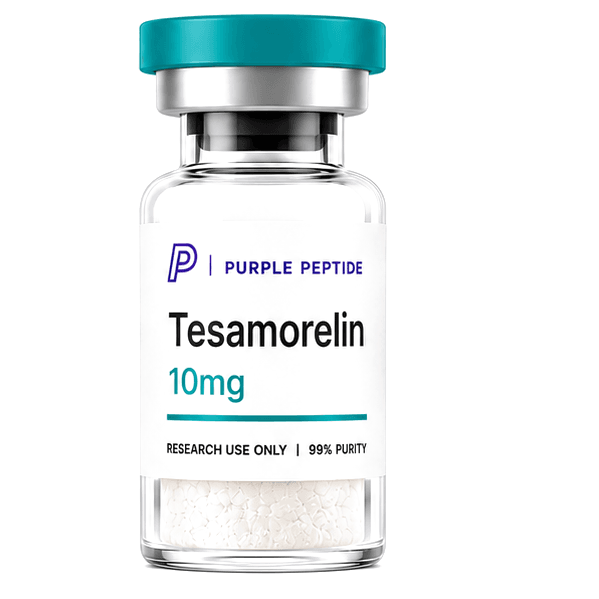
Tesamorelin research vial
Sequence length
44 AA
Molecular weight
5135.8 g/mol
Current batch
TESAM202605
Metabolic · Metabolic / GH-axis research

Tesamorelin

Stabilized 44-amino-acid analog of human growth hormone-releasing hormone (GHRH)

Tesamorelin (10mg vials)

Sign up for verified researcher access to view pricing, see in-stock quantity, and order at member volume tiers (up to 20% off at 20+ vials).

Sign up to view pricing and order.Verified researchers only. Active immediately on sign-up.
Apply for access →

Specifications

Molecular weight5135.8 g/mol
Sequence length44 amino acids
Amino acid sequencetrans-3-hexenoyl-Tyr-Ala-Asp-Ala-Ile-Phe-Thr-Asn-Ser-Tyr-Arg-Lys-Val-Leu-Gly-Gln-Leu-Ser-Ala-Arg-Lys-Leu-Leu-Gln-Asp-Ile-Met-Ser-Arg-Gln-Gln-Gly-Glu-Ser-Asn-Gln-Glu-Arg-Gly-Ala-Arg-Ala-Arg-Leu-NH2
AppearanceWhite lyophilized powder
SolubilityBacteriostatic water; sterile water
Storage (lyophilized)-20°C, protected from light
Storage (reconstituted)2–8°C, use within 28 days
Half-lifeApproximately 26 minutes after subcutaneous administration
Current batch purity99.15% (HPLC) · TESAM202605

Tesamorelin is a stabilized 44-amino-acid synthetic analog of human growth hormone-releasing hormone (GHRH). The molecule is the native GHRH(1–44) sequence with an N-terminal trans-3-hexenoyl modification that protects it from rapid degradation by dipeptidyl peptidase-4 (DPP-4), extending its half-life relative to unmodified GHRH. Tesamorelin is widely studied in clinical and laboratory settings for its effects on the pituitary GH/IGF-1 axis, visceral adipose tissue biology, and hepatic lipid metabolism. NovaWell supplies Tesamorelin as a lyophilized powder, third-party tested for purity and endotoxin conformance, for laboratory research use only.

Research Studies

The following studies are summarized for educational purposes only. Inclusion does not imply any human use; citations are provided so researchers can locate primary literature.

Research study

Metabolic Effects of a Growth Hormone–Releasing Factor in Patients with HIV

Falutz J, Allas S, Blot K, Potvin D, Kotler D, Somero M, Berger D, Brown S, Richmond G, Fessel J, Turner R, Grinspoon S. N Engl J Med. 2007;357(23):2359–2370. View source ↗

Scientific findings

This 26-week multicenter, double-blind, placebo-controlled Phase 3 study randomized 412 adults with HIV-associated abdominal fat accumulation to a daily 2 mg subcutaneous dose of tesamorelin or placebo. The primary endpoint was percent change in visceral adipose tissue (VAT) measured by computed tomography. Tesamorelin produced a mean VAT reduction of approximately 15.2% from baseline, compared with a 5% increase in the placebo arm (between-group difference p<0.001). Triglycerides and the cholesterol-to-HDL ratio improved in the tesamorelin arm, and IGF-1 rose into the upper-normal physiologic range consistent with pulsatile pituitary GH release rather than exogenous GH administration. Glucose parameters and adverse event rates were broadly similar between arms over the 26-week window. The authors concluded that tesamorelin selectively reduced visceral adiposity through stimulation of endogenous GH secretion.

Plain English

This was the large landmark trial that established what tesamorelin does in humans. Roughly 400 people received either tesamorelin or a placebo injection daily for six months, and researchers measured belly fat with CT scans. The tesamorelin group lost about 15% of their visceral (deep abdominal) fat, while the placebo group gained a little. Importantly, tesamorelin worked by telling the body's own pituitary gland to release growth hormone in its natural rhythm, rather than by adding outside growth hormone.

Research study

Effect of Tesamorelin on Visceral Fat and Liver Fat in HIV-Infected Patients With Abdominal Fat Accumulation: A Randomized Clinical Trial

Stanley TL, Feldpausch MN, Oh J, Branch KL, Lee H, Torriani M, Grinspoon SK. JAMA. 2014;312(4):380–389. View source ↗

Scientific findings

This 6-month, double-blind, randomized clinical trial enrolled 50 HIV-positive participants with abdominal fat accumulation and assigned them to tesamorelin 2 mg subcutaneously daily or placebo, with the primary endpoint being change in hepatic fat fraction measured by proton magnetic resonance spectroscopy (1H-MRS). Tesamorelin produced a significant absolute reduction in hepatic fat fraction relative to placebo (between-group effect approximately -2.9%, p=0.003), corresponding to a roughly 37% relative reduction in liver fat. Visceral adipose tissue also decreased significantly versus placebo, and IGF-1 rose within the physiologic range. Fasting glucose and HbA1c were unchanged between arms across the trial. The authors interpreted the data as evidence that GHRH-axis stimulation can favorably alter ectopic fat distribution in the liver, not only the visceral depot.

Plain English

This study asked whether tesamorelin affects fat stored inside the liver, not just belly fat. Fifty participants received daily tesamorelin or placebo for six months, and researchers used a specialized MRI to measure how much fat was sitting inside their liver tissue. The tesamorelin group saw their liver fat drop by about a third compared with placebo. This was important because excess liver fat is linked to a range of metabolic conditions, and the finding suggested the GHRH pathway can influence where the body stores fat at a deeper level than was previously documented.

Storage & handling

Lyophilized (unreconstituted): Store at -20°C, protected from light. Stable for 24+ months under correct storage. Avoid repeated temperature cycling. Tesamorelin is light-sensitive — keep vials in opaque packaging during transit and intermediate storage.

Reconstituted: Dissolve in bacteriostatic water (typically 2–3 mL per 10 mg vial, depending on the research protocol). Store reconstituted solution at 2–8°C and use within 28 days. Do not freeze reconstituted solution.

Vial format: 10 mg lyophilized, vacuum-sealed glass vial with rubber stopper and aluminum crimp. Sterility tested per USP guidelines.

Shipping: Lyophilized Tesamorelin is stable at ambient temperature for the typical 1–3 day shipping window. Cold-pack shipping available on request.

Frequently asked questions

What is Tesamorelin?+

Tesamorelin is a stabilized 44-amino-acid analog of human growth hormone-releasing hormone (GHRH). It is the full-length native GHRH(1–44) sequence with a trans-3-hexenoyl group attached at the N-terminus. This modification blocks rapid cleavage by dipeptidyl peptidase-4 (DPP-4), extending the molecule's half-life compared to unmodified GHRH. In research models, tesamorelin binds the pituitary GHRH receptor and stimulates pulsatile endogenous growth hormone secretion.

What is the peptide sequence and molecular weight?+

Tesamorelin is a 44-amino-acid peptide amide with a trans-3-hexenoyl modification at the N-terminus and a C-terminal amide. Its molecular formula is C221H366N72O67S and its molecular weight is approximately 5135.8 g/mol. The full sequence is: trans-3-hexenoyl-Tyr-Ala-Asp-Ala-Ile-Phe-Thr-Asn-Ser-Tyr-Arg-Lys-Val-Leu-Gly-Gln-Leu-Ser-Ala-Arg-Lys-Leu-Leu-Gln-Asp-Ile-Met-Ser-Arg-Gln-Gln-Gly-Glu-Ser-Asn-Gln-Glu-Arg-Gly-Ala-Arg-Ala-Arg-Leu-NH2.

What does NovaWell test Tesamorelin for?+

Every batch of Tesamorelin supplied by NovaWell is tested by an independent third-party laboratory for: identity and purity (HPLC + MS), bacterial endotoxin (USP <85>), heavy metals (USP), and sterility (USP). The Certificate of Analysis for the currently shipping batch is linked from the Certificates tab on this page, along with the test date, manufacturer ID, and the independent laboratory that performed the analysis. Recent batches have tested above 99% pure by HPLC.

How is Tesamorelin different from Sermorelin?+

Both Tesamorelin and Sermorelin are GHRH analogs that act at the pituitary GHRH receptor, but they differ in length and stability. Sermorelin is GHRH(1–29) — the shortest active fragment of native GHRH at 29 amino acids — and is rapidly degraded by DPP-4 in plasma, giving it a half-life of only a few minutes. Tesamorelin retains the full 44-amino-acid native GHRH sequence and adds an N-terminal trans-3-hexenoyl group that confers resistance to DPP-4, producing a longer functional half-life and a more sustained GHRH-receptor stimulus in research models.

How does Tesamorelin compare to CJC-1295?+

Tesamorelin and CJC-1295 are both GHRH-axis molecules but differ in structure and pharmacokinetics. CJC-1295 is a tetrasubstituted analog of GHRH(1–29) — the same 29-amino-acid backbone as Sermorelin, but with four amino acid substitutions that resist enzymatic breakdown. The "CJC-1295 with DAC" variant adds a maleimide linker that binds covalently to serum albumin, extending its half-life to roughly 6–8 days; "CJC-1295 no DAC" (also known as Mod GRF 1-29) lacks the linker and has a half-life closer to 30 minutes. Tesamorelin retains the full 44-amino-acid sequence with a hexenoyl modification, sitting between these molecules on the half-life spectrum.

How should Tesamorelin be stored after reconstitution?+

Once reconstituted in bacteriostatic water, Tesamorelin should be stored at 2–8°C, protected from light, and used within 28 days. Do not freeze the reconstituted solution — freeze-thaw cycles can compromise peptide integrity. The lyophilized powder is stable at -20°C for 24+ months when kept protected from light and away from temperature cycling.

Where does NovaWell source Tesamorelin?+

NovaWell sources Tesamorelin from a vetted synthesis partner under our supplier qualification protocol, which includes facility audits and review of internal QC documentation. Every batch is then independently verified by a third-party laboratory before release. The manufacturer ID and batch number for the currently shipping vial are listed in the Description tab and on the linked Certificate of Analysis.