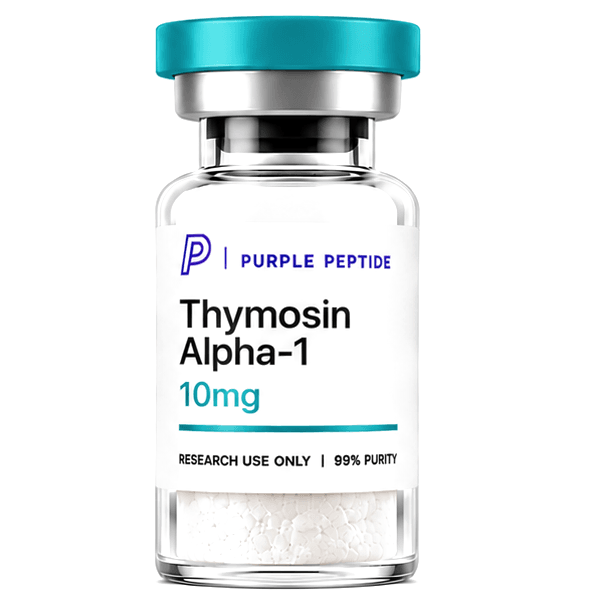
Thymosin Alpha-1 research vial
Sequence length
28 AA
Molecular weight
3108.32 g/mol
Current batch
THYMO202606
Immune · Immunology / T-cell and dendritic cell research

Thymosin Alpha-1

28-amino-acid thymic peptide studied as an immune-system modulator

Thymosin Alpha-1 (10mg vials)

Sign up for verified researcher access to view pricing, see in-stock quantity, and order at member volume tiers (up to 20% off at 20+ vials).

Sign up to view pricing and order.Verified researchers only. Active immediately on sign-up.
Apply for access →

Specifications

Molecular weight3108.32 g/mol
Sequence length28 amino acids
Amino acid sequenceAc-Ser-Asp-Ala-Ala-Val-Asp-Thr-Ser-Ser-Glu-Ile-Thr-Thr-Lys-Asp-Leu-Lys-Glu-Lys-Lys-Glu-Val-Val-Glu-Glu-Ala-Glu-Asn
Molecular formulaC129H215N33O55
AppearanceWhite lyophilized powder
SolubilityBacteriostatic water; sterile water
Storage (lyophilized)-20°C, protected from light
Storage (reconstituted)2–8°C, use within 14 days
Half-lifeApproximately 2 hours systemic; downstream immune-cell effects persist longer
Current batch purity99.38% (HPLC) · THYMO202606

Thymosin Alpha-1 (Tα1) is a 28-amino-acid, N-terminally acetylated peptide originally isolated from bovine thymus by Goldstein and colleagues in 1972 and later chemically synthesized. The acetylated sequence Ac-SDAAVDTSSEITTKDLKEKKEVVEEAEN (molecular weight ~3108 g/mol) is among the most extensively studied thymic peptides in immunology research, with reported effects on T-cell maturation, dendritic cell function, and Toll-like receptor signaling. Thymosin Alpha-1 is approved as an immunomodulator in more than thirty countries outside the United States; it is not FDA-approved in the US. NovaWell supplies Thymosin Alpha-1 as a lyophilized powder, third-party tested for purity and endotoxin conformance, for laboratory research use only.

Research Studies

The following studies are summarized for educational purposes only. Inclusion does not imply any human use; all referenced research was conducted in vitro, in animal models, or as a review of the published literature.

Research study

Thymosin alpha1 activates dendritic cell tryptophan catabolism and establishes a regulatory environment for balance of inflammation and tolerance

Romani L, Bistoni F, Perruccio K, Montagnoli C, Gaziano R, Bozza S, Bonifazi P, Bistoni G, Rasi G, Velardi A, Fallarino F, Garaci E, Puccetti P. Blood. 2006;108(7):2265–2274. View source ↗

Scientific findings

This combined in vitro and in vivo study examined how Thymosin Alpha-1 acts on dendritic cells (DCs). The authors reported that Tα1 primes DCs for antifungal T-helper type 1 responses via Toll-like receptor 9 (TLR9) signaling, while simultaneously activating indoleamine 2,3-dioxygenase (IDO) — a tryptophan-catabolizing enzyme associated with immune regulation. IDO activation by Tα1 required both TLR9 signaling and the type I interferon receptor, and resulted in interleukin-10 production and generation of regulatory T cells. In adoptive transfer experiments using murine models of fungal infection and alloantigen exposure, Tα1-primed DCs supported both Th1 priming and a regulatory environment within the same cell population. The authors propose that Tα1 acts at the interface of innate pattern recognition and adaptive immune tolerance.

Plain English

Scientists looked at how Thymosin Alpha-1 affects dendritic cells — the immune cells that decide what the rest of the immune system attacks and what it leaves alone. They found that Tα1 flips two switches in these cells at the same time: one that revs up the response to fungal infections, and a second that produces a "calming" signal to keep inflammation from running out of control. The peptide does this through a receptor called TLR9, which normally detects bacterial and viral DNA. The result is a more balanced immune response — strong enough to fight an infection, but with built-in brakes against tissue damage. This dual signaling helps explain why Tα1 is studied in conditions where the immune system is either too weak or too inflamed.

Research study

Thymosin alpha 1: A comprehensive review of the literature

Dominari A, Hathaway III D, Pandav K, Matos W, Biswas S, Reddy G, Thevuthasan S, Khan MA, Mathew A, Makkar SS, Zaidi M, Fahem MMM, Beas R, Castaneda V, Paul T, Halpern J, Baralt D. World J Virol. 2020;9(5):67–78. View source ↗

Scientific findings

This open-access review synthesizes nearly five decades of published research on Thymosin Alpha-1, from its initial isolation from thymus tissue through contemporary mechanistic and clinical literature. The authors cover Tα1's chemistry (28-amino-acid acetylated peptide, ~3.1 kDa), its endogenous production from prothymosin alpha, and its documented effects on T-cell maturation, dendritic cell activation via TLR2/TLR9, NK cell function, and cytokine signaling (notably IFN-α, IFN-γ, IL-2, and IL-12). The review tabulates published research across hepatitis B and C, sepsis, immune reconstitution in immunocompromised populations, and adjuvant use with vaccines, summarizing the regulatory landscape in which Tα1 is approved as an immunomodulator in more than thirty countries while remaining unapproved in the United States. The authors identify gaps in the mechanistic literature and call for additional controlled studies.

Plain English

This is a "review of reviews" — a single paper that pulls together what the scientific community has learned about Thymosin Alpha-1 since it was first identified in 1972. The authors walk through what the peptide is chemically, where it comes from in the body, the immune cells it acts on, and the published research that has been conducted across multiple conditions. They note that the peptide is approved as an immune modulator in more than thirty countries outside the US, while pointing out which questions about mechanism and clinical use remain open. It is a useful starting point for a researcher trying to get oriented to the Tα1 literature.

Storage & handling

Lyophilized (unreconstituted): Store at -20°C, protected from light. Stable for 24+ months under correct storage. Brief excursions to refrigerated temperatures during shipping are tolerated. Avoid repeated freeze-thaw cycling.

Reconstituted: Dissolve in bacteriostatic water (typically 2–3 mL per 10 mg vial, depending on the research protocol). Store reconstituted solution at 2–8°C and use within 14 days. Do not freeze reconstituted solution.

Vial format: 10 mg lyophilized, vacuum-sealed glass vial with rubber stopper and aluminum crimp. Sterility tested per USP guidelines.

Shipping: Lyophilized Thymosin Alpha-1 is stable at ambient temperature for the typical 1–3 day shipping window. Cold-pack shipping available on request.

Frequently asked questions

What is Thymosin Alpha-1?+

Thymosin Alpha-1 (Tα1) is a 28-amino-acid, N-terminally acetylated peptide originally isolated from bovine thymus by Allan Goldstein's group in 1972 and now produced by chemical synthesis. It is one of the most extensively studied peptides in the immunology literature and is approved as an immunomodulator in more than thirty countries outside the United States. Tα1 is not approved by the FDA for any indication in the US; NovaWell supplies Tα1 strictly as a research compound.

What is the mechanism of action of Thymosin Alpha-1?+

Published research describes Tα1 as acting primarily on dendritic cells and T cells. The most-cited mechanism is activation of Toll-like receptor 9 (TLR9), which primes dendritic cells for Th1 responses while simultaneously inducing the regulatory enzyme indoleamine 2,3-dioxygenase via type I interferon signaling (Romani et al., Blood 2006). Downstream effects reported in the literature include modulation of IFN-α, IFN-γ, IL-2, IL-10, and IL-12, along with effects on NK cell and CD8+ T-cell function. See the Research Studies section above for primary citations.

What is the amino acid sequence of Thymosin Alpha-1?+

Thymosin Alpha-1 is the 28-amino-acid sequence Ac-Ser-Asp-Ala-Ala-Val-Asp-Thr-Ser-Ser-Glu-Ile-Thr-Thr-Lys-Asp-Leu-Lys-Glu-Lys-Lys-Glu-Val-Val-Glu-Glu-Ala-Glu-Asn (Ac-SDAAVDTSSEITTKDLKEKKEVVEEAEN). The N-terminal serine is acetylated, which is essential for the peptide's documented biological activity. The molecular formula is C129H215N33O55 with a molecular weight of approximately 3108.32 g/mol.

What does NovaWell test Thymosin Alpha-1 for?+

Every batch of Thymosin Alpha-1 supplied by NovaWell is tested by an independent third-party laboratory for: identity and purity (HPLC + MS), bacterial endotoxin (USP <85>), heavy metals (USP), and sterility (USP). N-terminal acetylation is verified by mass spectrometry. The Certificate of Analysis for the currently shipping batch is linked from the Certificates tab on this page.

What is the difference between Thymosin Alpha-1 and Thymosin Beta-4?+

Despite the shared "thymosin" name, Tα1 and Thymosin Beta-4 (TB-4) are structurally and functionally unrelated peptides — they were grouped together historically because both were isolated from early thymus extracts, not because they share sequence homology. Tα1 is a 28-amino-acid peptide derived from prothymosin alpha and is studied for effects on dendritic cell and T-cell function via TLR signaling. Thymosin Beta-4 is a 43-amino-acid peptide that binds and sequesters G-actin, and is studied for effects on cell migration, angiogenesis, and tissue repair. The two are studied for largely different research questions; see our TB-500 (Thymosin Beta-4) page.

How should Thymosin Alpha-1 be stored after reconstitution?+

Once reconstituted in bacteriostatic water, Thymosin Alpha-1 should be stored at 2–8°C and used within 14 days. Do not freeze reconstituted solution, as freeze-thaw can promote aggregation in 28-mer peptides. The lyophilized powder is stable at -20°C for 24+ months when protected from light.