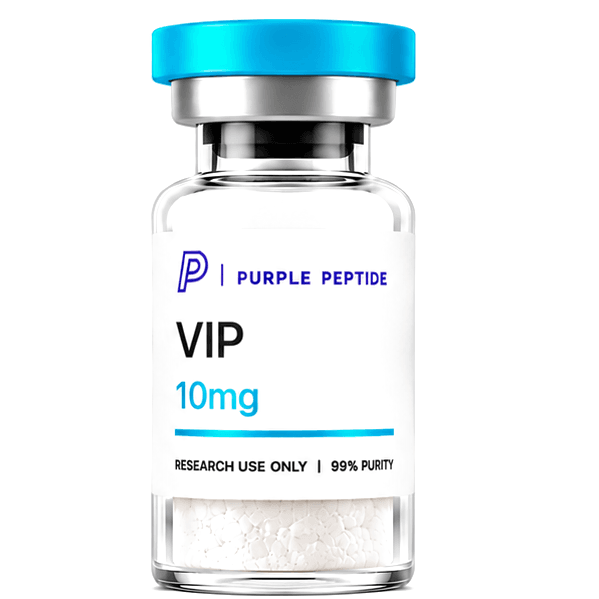
VIP research vial
Sequence length
28 AA
Molecular weight
3326.8 g/mol
Current batch
VIP202603
Vascular · Immune modulation / Vasoactive neuropeptide research

VIP

28-amino-acid neuropeptide of the secretin/glucagon family

VIP (10mg vials)

Sign up for verified researcher access to view pricing, see in-stock quantity, and order at member volume tiers (up to 20% off at 20+ vials).

Sign up to view pricing and order.Verified researchers only. Active immediately on sign-up.
Apply for access →

Specifications

Molecular weight3326.8 g/mol
Sequence length28 amino acids
Amino acid sequenceHSDAVFTDNYTRLRKQMAVKKYLNSILN-NH2
AppearanceWhite lyophilized powder
SolubilityBacteriostatic water; sterile water
Storage (lyophilized)-20°C, protected from light
Storage (reconstituted)2–8°C, use within 28 days
Half-lifeShort systemic half-life (~5–10 minutes in plasma)
Current batch purity99.88% (HPLC) · VIP202603

Vasoactive Intestinal Peptide (VIP) is a 28-amino-acid neuropeptide originally isolated from porcine duodenum by Sami Said and Viktor Mutt in 1970. It is a member of the secretin/glucagon peptide superfamily and is C-terminally amidated (HSDAVFTDNYTRLRKQMAVKKYLNSILN-NH2, MW ~3326.8 g/mol). VIP signals through two class B G-protein-coupled receptors, VPAC1 and VPAC2, and has been studied extensively for its roles in vasodilation, smooth muscle relaxation, immune cell signaling, and circadian biology. NovaWell supplies VIP as a lyophilized powder, third-party tested for purity and endotoxin conformance, for laboratory research use only.

Research Studies

The following studies are summarized for educational purposes only. Inclusion does not imply any human use; all referenced research was conducted in vitro, in animal models, or as published clinical investigations.

Research study

Vasoactive intestinal peptide: a neuropeptide with pleiotropic immune functions

Delgado M, Ganea D. Amino Acids. 2013;45(1):25–39. View source ↗

Scientific findings

This review consolidates two decades of laboratory work on VIP as an endogenous immunoregulatory peptide. The authors summarize evidence that VIP is produced not only by neurons but also by activated T cells and other immune cells, and that it binds two class B G-protein-coupled receptors — VPAC1 (constitutively expressed on resting lymphocytes and macrophages) and VPAC2 (induced upon immune activation). Downstream, VIP signaling raises intracellular cAMP and modulates transcription factors including CREB, NF-κB, and AP-1. In cultured macrophages and dendritic cells, VIP exposure was associated with reduced production of pro-inflammatory mediators (TNF-α, IL-6, IL-12) and increased anti-inflammatory IL-10 output. In CD4 T cell cultures, VIP shifted differentiation away from Th1/Th17 phenotypes and favored induction of regulatory T cells via tolerogenic dendritic cells. The authors place these findings in the broader context of in vivo rodent models of autoimmune and chronic inflammatory disease.

Plain English

This paper pulls together years of research showing that VIP is not just a gut and nerve peptide — it is also made by immune cells and acts as a brake on inflammation. The authors describe how VIP attaches to two receptors (VPAC1 and VPAC2) on immune cells and changes which signals those cells send out. In laboratory studies, VIP reduced the alarm signals immune cells release during inflammation and increased calming signals instead. It also pushed certain T cells toward a "regulatory" state, which is a normal mechanism the body uses to keep immune responses from running unchecked.

Research study

Inhaled Vasoactive Intestinal Peptide Exerts Immunoregulatory Effects in Sarcoidosis

Prasse A, Zissel G, Lützen N, Schupp J, Schmiedlin R, Gonzalez-Rey E, Rensing-Ehl A, Bacher G, Cavalli V, Bevec D, Delgado M, Müller-Quernheim J. Am J Respir Crit Care Med. 2010;182(4):540–548. View source ↗

Scientific findings

This open-label phase II clinical investigation enrolled 20 adults with biopsy-confirmed pulmonary sarcoidosis. Participants received nebulized VIP (100 μg, four times daily) for four weeks. The primary readouts were bronchoalveolar lavage (BAL) cytokine profiles and T cell subset composition before and after the inhalation period. The authors reported a reduction in TNF-α release from BAL cells and an increase in the proportion of CD4+CD25+FoxP3+ regulatory T cells in BAL fluid post-treatment. No serious adverse events were reported during the inhalation period. The authors interpret the findings as the first in-human demonstration that inhaled VIP exerts immunoregulatory effects on the pulmonary compartment, consistent with prior animal model literature, and call for larger controlled trials.

Plain English

Researchers in Germany tested whether inhaled VIP could change the immune signaling inside the lungs of people with sarcoidosis, a condition where the immune system forms small clumps of cells (granulomas) in the lungs. Twenty participants inhaled VIP four times a day for four weeks. Afterwards, the inflammatory signal TNF-α from lung-fluid samples was lower, and the proportion of "regulatory" T cells (the calming kind) was higher. The participants tolerated the inhalation. This was the first study showing that VIP, delivered straight to the lungs, produces measurable immune-system changes in humans — a finding that motivated further investigation.

Storage & handling

Lyophilized (unreconstituted): Store at -20°C, protected from light. Stable for 24+ months under correct storage. Avoid repeated temperature cycling, as VIP is sensitive to repeated freeze-thaw.

Reconstituted: Dissolve in bacteriostatic water (typically 1–2 mL per 10 mg vial, depending on the research protocol). Store reconstituted solution at 2–8°C and use within 28 days. Do not freeze reconstituted solution. Single-use aliquoting is recommended for protocols requiring extended storage.

Vial format: 10 mg lyophilized, vacuum-sealed glass vial with rubber stopper and aluminum crimp. Sterility tested per USP guidelines.

Shipping: Lyophilized VIP is stable at ambient temperature for the typical 1–3 day shipping window. Cold-pack shipping available on request for researchers whose protocol requires it.

Frequently asked questions

What is VIP and what peptide family does it belong to?+

VIP (Vasoactive Intestinal Peptide) is a 28-amino-acid neuropeptide first isolated from porcine duodenum by Sami Said and Viktor Mutt in 1970. It belongs to the secretin/glucagon peptide superfamily, which also includes secretin, glucagon, GLP-1, GIP, PACAP, and growth hormone-releasing hormone. Its sequence is HSDAVFTDNYTRLRKQMAVKKYLNSILN-NH2, with a C-terminal amide group, and a molecular weight of approximately 3326.8 g/mol.

What receptors does VIP bind, and where are they expressed?+

VIP binds two class B G-protein-coupled receptors: VPAC1 and VPAC2. VPAC1 is constitutively expressed on resting lymphocytes, macrophages, vascular smooth muscle, and many epithelial tissues. VPAC2 expression is more restricted at baseline and is upregulated on activated immune cells. Both receptors signal primarily through Gs-coupled activation of adenylyl cyclase and elevation of intracellular cAMP. VIP also binds the related PAC1 receptor with lower affinity; PAC1 is the primary receptor for the related peptide PACAP.

What does NovaWell test VIP for?+

Every batch of VIP supplied by NovaWell is tested by an independent third-party laboratory for: identity and purity by HPLC and mass spectrometry, bacterial endotoxin per USP <85>, heavy metals per USP, and sterility per USP. The Certificate of Analysis for the currently shipping batch is linked from the Certificates tab on this page, with manufacturer ID and the independent laboratory that performed the analysis.

How should VIP be stored after reconstitution?+

Once reconstituted in bacteriostatic water, VIP should be stored at 2–8°C and used within 28 days. Do not freeze reconstituted solution. The lyophilized powder is stable at -20°C for 24+ months when protected from light and moisture. VIP is sensitive to repeated freeze-thaw cycles, so single-use aliquoting is recommended for research protocols requiring extended storage of the reconstituted material.

Where does NovaWell source VIP?+

NovaWell sources VIP from a vetted synthesis partner under our supplier qualification protocol, which includes facility audits and review of internal QC documentation. Every batch is then independently verified by a third-party laboratory before release. The manufacturer ID for the currently shipping batch is listed in the Description tab.

Is VIP stable in shipping?+

Lyophilized VIP is stable at ambient temperature for the standard 1–3 day shipping window. Long-term storage requires -20°C with protection from light. We offer cold-pack shipping on request for any researcher whose protocol calls for it.